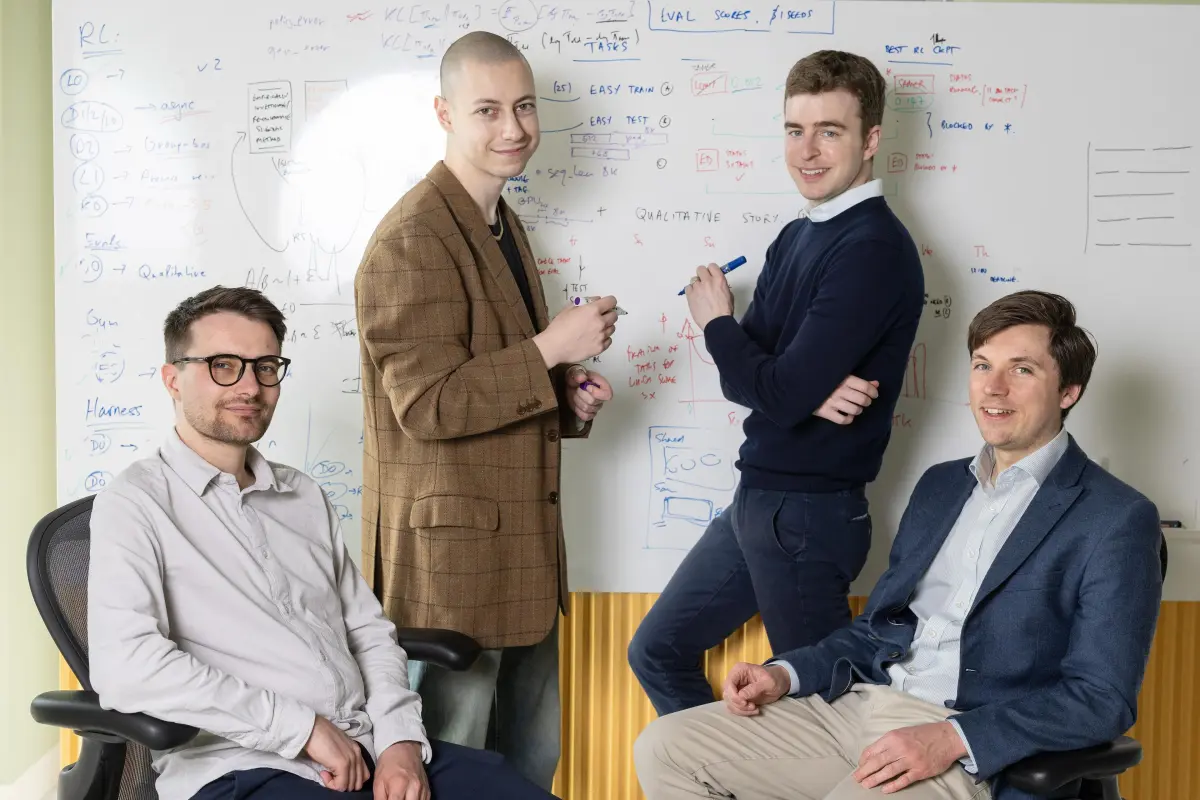
Inherent , a London AI lab founded by Google DeepMind alumni , says its AI agent just outperformed much larger models from Anthropic and OpenAI using a fraction of the size. Of all the startups launched by Google DeepMind alumni, Inherent has gotten relatively little attention. But while better-funded rivals have yet to show the world anything concrete, the London-based team is starting to share what it's been building.
Just weeks after emerging from stealth with a $50 million seed round , the British startup says its newly released AI agent, Faraday , has outperformed larger, better-known models at a specific task: independently reproducing the findings of published scientific papers without being told the answer in advance. That may sound like a mere party trick given Inherent's much loftier goal — building AI that can discover new scientific knowledge and not just verify old results. But paper replication is a standard training exercise for human scientists, too, cofounder and chief scientist Edward Hughes said.
"Many PhD students actually start by doing this. " Beating other AI systems at the task wasn't the point, Hughes told TechCrunch; how they got there was. "What was most interesting to us about this was not so much the result of beating those frontier agents — which of course we liked — but was actually the way we went about building this. " Here's the part that should catch an investor's eye: measured against Anthropic's Claude Opus 4. 5 — both much larger, frontier-scale systems — Faraday runs on a comparatively tiny model called Qwen 3. 6 that has just 27 billion parameters.
(Roughly speaking, "parameters" is a proxy for a model's size and, typically, its training costs, as well. ) Inherent's bar for success was also higher than simply accuracy. Beyond replicating results, it wanted Faraday to demonstrate "research taste" — an instinct for what experiments are worth running and how to design them well. Teaching something as intangible as taste is hard, which is where reinforcement learning comes in. It's a training method that rewards an AI system for good outcomes rather than spelling out rules for it to follow.