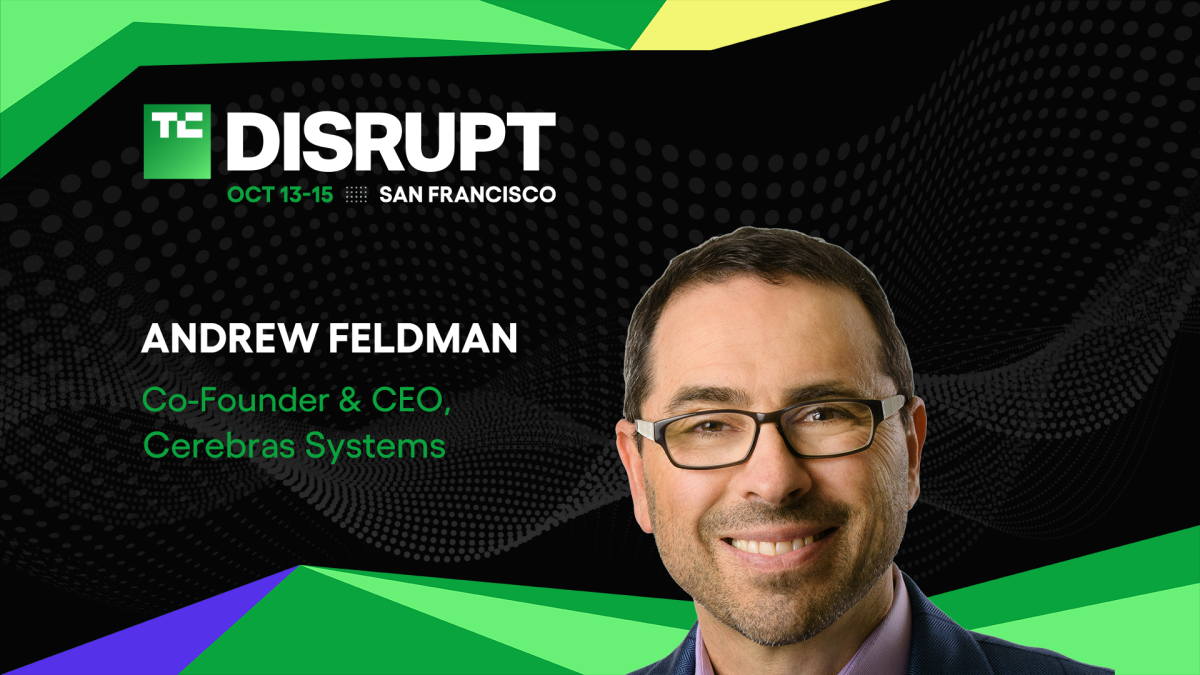
AI models keep getting more capable. But every leap forward demands more compute, energy, and infrastructure. How far can that continue? Cerebras Systems has spent the past decade challenging a basic assumption behind AI computing: that increasingly powerful AI must depend on conventional chip architectures. The company built its approach around wafer-scale computing and today provides AI compute through on-premise systems and its cloud platform. Want to understand what could determine how far AI can scale? Secure your Disrupt ticket to hear from a founder solving the AI scale challenge.
Bring a co-founder, colleague, or peer at 50% off . Andrew Feldman co-founded Cerebras in 2015 after years of building companies around computing infrastructure. Before Cerebras, he co-founded and led energy-efficient microserver startup SeaMicro, which AMD acquired in 2012. Earlier, he held leadership roles at Force10 Networks and Riverstone Networks. At Cerebras, Feldman and his co-founders took on a problem long considered impractical: bringing wafer-scale computing to market.
Rather than cutting a silicon wafer into individual chips, Cerebras developed a processor built on the wafer itself, an architecture designed specifically for demanding AI workloads. Now Cerebras is scaling that approach as demand for AI compute grows. 5 billion in its May IPO and signed a multiyear agreement with OpenAI to deploy 750 megawatts of Cerebras systems from 2026 through 2028. In August, Cerebras introduced CS-4, the latest generation of its wafer-scale AI infrastructure. Can approaches like Cerebras’ deliver the compute increasingly powerful AI demands — and can the infrastructure behind them keep up?
Secure your Disrupt pass , get a second at 50% off, and hear from an entrepreneur who has spent more than a decade betting on a different way to build AI hardware. More powerful processors alone don’t solve the scaling problem. Those systems need data centers, electricity, cooling, and manufacturing capacity. Cerebras is already confronting that challenge. In August, the company reported more than 600 megawatts of data center capacity live or under contract for delivery by the end of 2027 and said it was increasing manufacturing capacity more than tenfold during 2026.