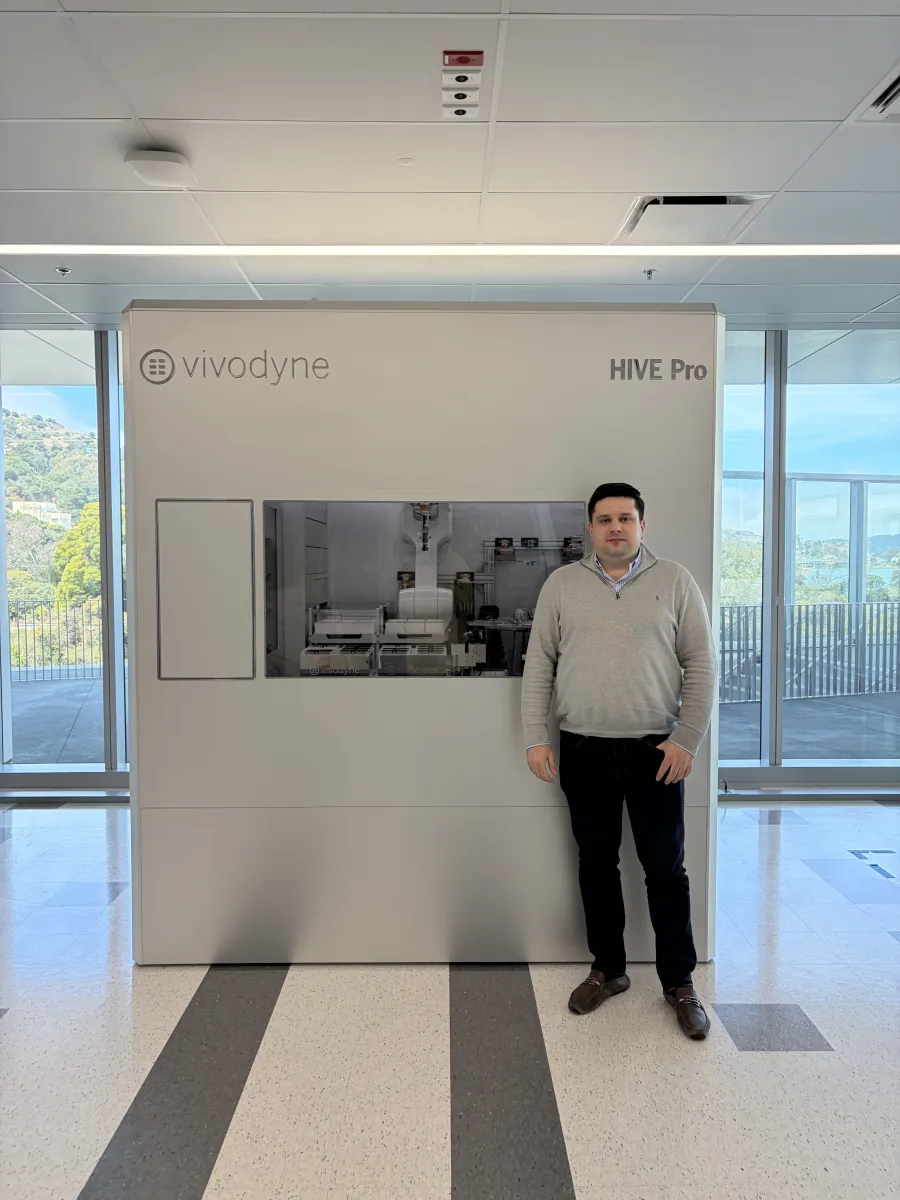
A biotech startup called Vivodyne says the AI drug-discovery industry has a data problem, and that it has built a machine to fix it. HIVE, modular robotic labs built by the company, can grow 20 kinds of human tissue, then autonomously dose and monitor them, generating the kind of causal biological data that today's AI models are missing — data that today mostly comes from animal testing, or studies of single cells or proteins, not living tissue. "Absent human testing, what are these [AI] models going to do? " asks Andrei Georgescu, Vivodyne's CEO and co-founder. "They're going to cure cancer in mice.
" Even Anthropic CEO Dario Amodei wrote over the weekend that claims that AI will cure cancer have become more cliche than credible — "the thing that will work is actually curing cancer, " as he put it. To be fair, the idea that AI will cure cancer is something Amodei himself has tossed out in previous essays; Sam Altman has repeatedly cited curing cancer as a justification for OpenAI's push toward AGI and ever-larger compute buildouts; and Google DeepMind's Demis Hassabis said last year that AI could potentially cure all disease within a decade. The actual results remain tepid.
A handful of AI-designed drugs have proceeded into human trials — one as far as Phase III, widespread human testing — but the reality is that the roadblocks aren't necessarily ones that AI can solve today. Nobel-prize winning Alphafold was a big advance for understanding the building blocks of life, but it has yet to actually produce a new drug. Isomorphic Labs, founded to build on Alphafold, is expecting its first trials, originally planned for 2025, by the end of this year.
In February, the company wrote that true drug discovery will require "highly accurate predictive models, across an expansive range of biochemical properties and interactions. " Georgescu says the space needs "a sanity check"— that existing models don't have the data to capture the complexity of human biology. It's a challenge already facing the pharmaceutical industry, where 90% of drugs that are effective in animal testing to enter clinical trials don't receive regulatory approval for humans. Vivodyne's plan is different.