Dive into our proprietary testing data and compare hardware with detailed benchmarks.
Go beyond the headlines with expert reporting on the hardware industry.
In-depth features, interviews and insider stories from the world of hardware.
When you purchase through links on our site, we may earn an affiliate commission. Here’s how it works .
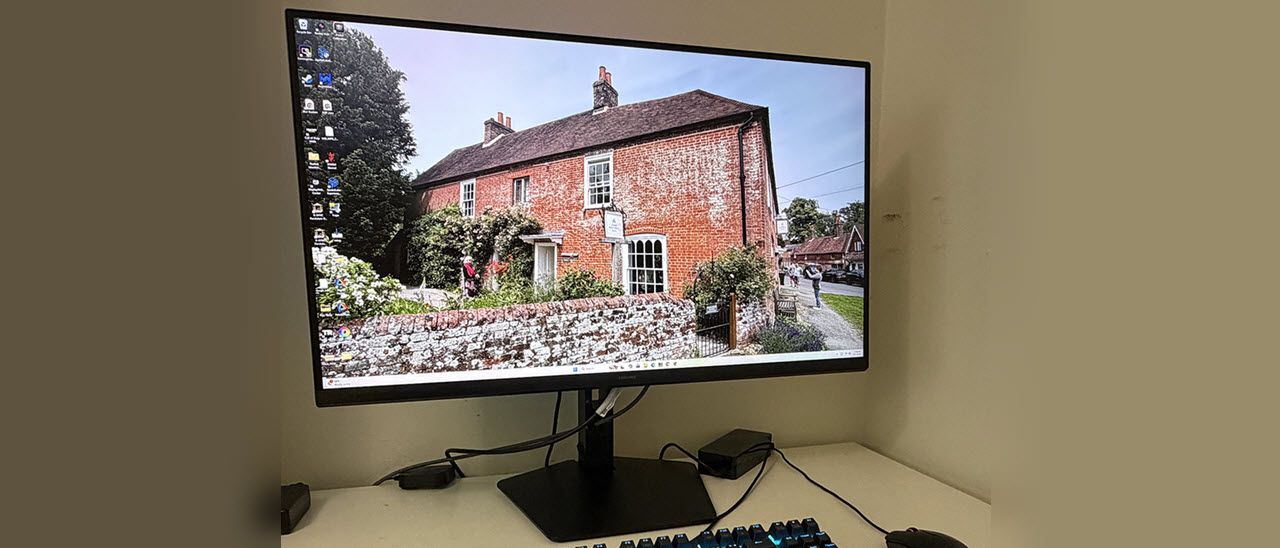
The Samsung Odyssey G80HS represents a solid step forward in the quest for greater pixel density with a gorgeous picture and speedy gaming performance. The dual refresh feature means it will work with a wide variety of systems, but it needs exotic hardware to perform at its peak.
Why you can trust Tom's Hardware Our expert reviewers spend hours testing and comparing products and services so you can choose the best for you. Find out more about how we test .
Since the advent of fixed-pixel flat panel displays, the quest for greater pixel density has not subsided. In times past, a high-res display was 1280x1024 with a 4:3 aspect ratio. Now the gold standard is 4K, 3840x2160. So, where do we go from here?
Traditionally, resolution increases in whole multiples like 1920x1080 to 3840x2160. And there are a few 8K 7680x4320 screens out there. But in the realm of the best gaming monitors , you can have any resolution you want, so why not 6K?
Samsung’s Odyssey G80HS is a 32-inch IPS panel with 6144x3456 pixels at 165 Hz and 3072x1728 pixels at 330 Hz along with Adaptive-Sync, HDR10, and wide gamut color. Pixel density is an impressive 224 or 112 ppi. Let’s take a look.
I’ll start with the caveat: the G80HS requires the latest port specification, DisplayPort 2.1 or HDMI 2.1 , to run in 6K at 165 Hz. You’ll also need an HDMI cable rated for 48 Gbps, or a DisplayPort cable rated for 80Gbps. You’ll also need a GeForce RTX 5090 to even dream of running over 120fps in 6K. That’s where the dual mode function comes in. Though 3072x1728 is unusual, it is a realistic task for an RTX 5090 or an RTX 4090 to move things along at 240 fps or more. That 330 Hz refresh rate is handy to have.
The panel uses Fast IPS technology with a claimed 1ms response time. It includes Adaptive-Sync and overdrive, but you can’t have both at the same time. I’ll talk more about that later. The good part is that input lag is extremely low, so gamers will get a responsive experience. And running at the higher refresh rate eliminates nearly all motion blur.
The panel doesn’t employ Quantum Dots but manages to cover just over 90% of DCI-P3 with solid out-of-box accuracy. With a few tweaks, I saw reference-level color, gamma and grayscale tracking. The G80HS also has an equally accurate sRGB mode for graphics pros, photographers, and users who want the correct BT.709 color space for SDR content. HDR10 signals are supported as well with expanded contrast and peak white levels around 480 nits.
The G80HS is clearly a gaming monitor with extras like LED lighting, aiming points and game-specific picture modes. You get all the latest video ports too with DisplayPort 2.1 and two HDMI 2.1 inputs. There are USBs for peripherals and a 3.5mm headphone jack. The only thing missing are internal speakers.
Get Tom's Hardware's best news and in-depth reviews, straight to your inbox.
Bleeding-edge resolution doesn’t come cheap, but the G80HS isn’t super pricey either at $1,599 to start. Let’s see how it performs.
The G80HS arrives packed in crumbly foam with a base, upright, and panel that assembles easily, no tools needed. A medium-sized power brick with right-angled cords provides the alternating current, and you get very thick HDMI and DisplayPort cables which are rated for 48 and 80 Gbps respectively.
The G80HS has a minimalist aesthetic with only a tiny Samsung logo on the front bezel. The rest of the frame is flush and thin. Coupled with a very slim side profile, one might think they’re looking at an OLED. Internal bits are packed into a central bulge which has generous ventilation. The stand’s fulcrum is ringed by an LED that can play a variety of effects and colors.
The stand is substantial with firm movements and generous adjustments. You get a five-inch height range plus 2/25 degrees tilt and 30 degrees swivel. There’s a 90-degree portrait mode as well. The base has a medium footprint and brings plenty of stability. I noted that the fulcrum had a little wobble when adjusting tilt and rotation.
The screen has an effective anti-glare coating with a matte finish. It is grain-free and provides excellent clarity for the extreme 224ppi pixel density. You’ll need a magnifying glass to see any dot structure from any distance. Sharp and smooth is almost an understatement.
The I/O panel includes a DisplayPort 2.1 and two HDMI 2.1 ports. All of them can manage 6K resolution at 165 Hz if your video card has DisplayPort 2.1 or HDMI 2.1 outputs. USB 3.2 ports are also included, one upstream and two downstream.