Dive into our proprietary testing data and compare hardware with detailed benchmarks.
Go beyond the headlines with expert reporting on the hardware industry.
In-depth features, interviews and insider stories from the world of hardware.
When you purchase through links on our site, we may earn an affiliate commission. Here’s how it works .
If you like the Naga V2 Pro, the V3 Pro is a solid upgrade — especially if you already have Razer's HyperPolling Wireless Dongle (or Mouse Dock Pro).
Why you can trust Tom's Hardware Our expert reviewers spend hours testing and comparing products and services so you can choose the best for you. Find out more about how we test .
If you know anything about me, you know I love a mouse with 19+ buttons. That's why I've been using Razer's Naga V2 Pro as my daily driver for the past three and a half years — and I have no regrets; it's on our list of best gaming mice for a reason. Thankfully, Razer must've heard my V2 Pro begging for its life, because there's a new multi-button MMO mouse in town with up to 23 programmable buttons: the Razer Naga V3 Pro.
The Naga V3 Pro is very similar to its predecessor at a glance — because Razer hasn't changed the mouse's form factor at all. It still comes with three swappable magnetic side plates (in 2-, 6- and 12-button layouts), but that's where the similarities end. The new Naga V3 Pro sports Razer's latest Focus Pro 50K gen-3 optical sensor, which has a maximum sensitivity of 50,000 DPI and a maximum speed of 930 IPS, and can handle up to 90 G's of force. It's not cheap, as the Naga lineup never has been, with an MSRP of $180 — pricier than most premium flagship gaming mice because it is, after all, all about versatility.
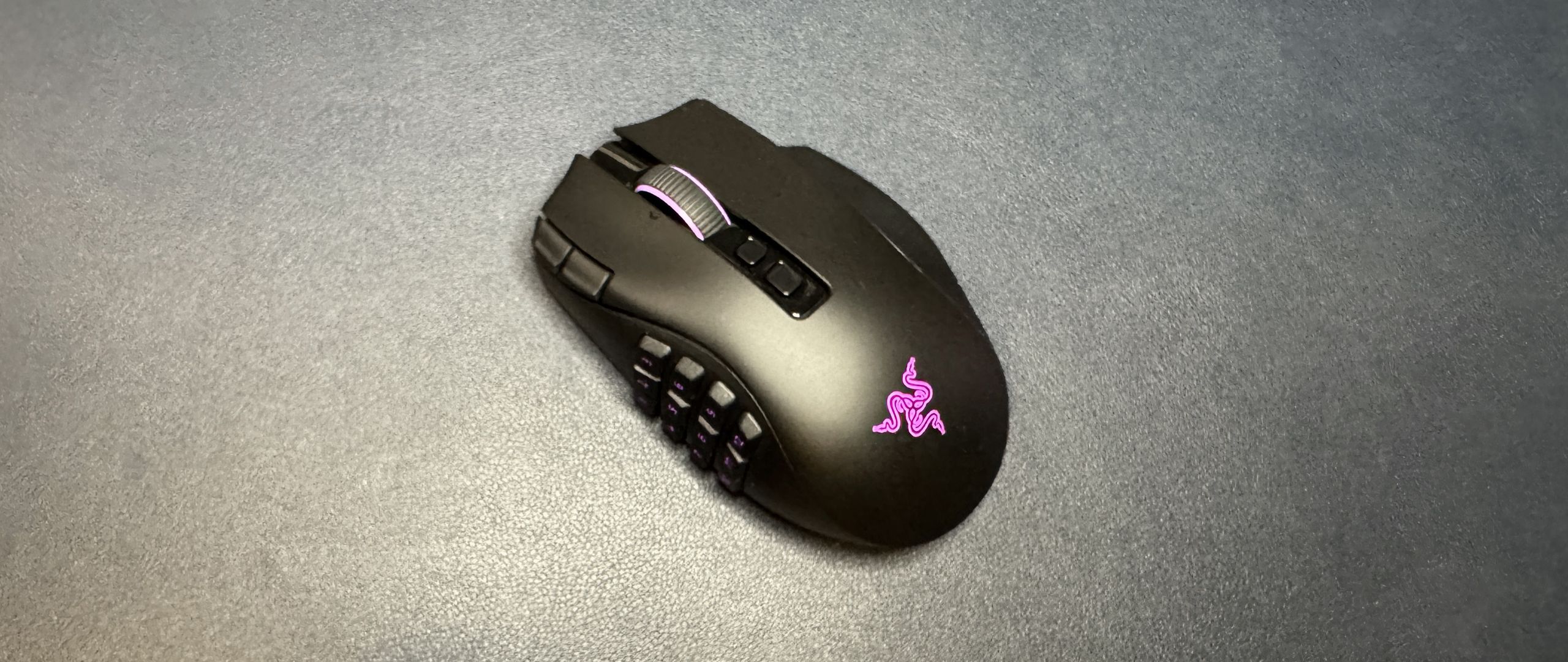
Like some of Razer's other new mice, the Naga V3 Pro has the exact same shape as its predecessor — it's a shorter, wider mouse than most flagship premium mice, measuring 4.7 x 2.97 x 1.72 inches (119.5 x 75.5 x 43.5mm). It's still a larger mouse overall, just a different shape. It has a right-handed ergonomic shape with a contoured thumb area, with interchangeable plates and a curved ring finger rest on the right side. It has a matte black plastic shell and features three RGB light zones in the scroll wheel, the logo on the palm rest, and on the side panel.
The mouse weighs slightly less than its predecessor: 3.9 ounces (112g) without the side plate or cable attached; the side plates weigh 20g (12-button), 17g (6-button), and 15g (2-button). The Naga V2 Pro weighed 134g regardless of the side plate. Its side plates — which are the same 12-button, 6-button, and 2-button layouts as the side plates from the Naga V2 Pro — now feature more durable double-shot molded keycaps, so they should last longer and the legends should remain crisp and readable throughout the mouse's lifetime (not that anyone is really looking at the legends on their mouse buttons).
The mouse has three buttons the Naga V2 Pro doesn't have — in addition to its primary left/right buttons, tilt wheel, two buttons above the tilt wheel, and profile switch on the bottom. There are now two edge buttons on the left side of the left mouse button (set by default to scroll up and down through DPI steps) and the ring finger rest has also been turned into a button (set by default to activate Razer's HyperShift for multi-layer inputs). I didn't have any problems with accidentally pressing the ring finger rest button, but there is a locking switch that lets you quickly disable it (it actually stops it from clicking at all, which is nice) if you do have issues.
The Naga V3 Pro has a multi-mode tilt wheel with three distinct modes: tactile, free-spin, and precision tactile. The scroll modes can be toggled off, but they aren't fully configurable like the customizable scroll feature in the Naga V2 Pro. This seems fine, though — the customizable scroll feature in the Naga V2 Pro seemed like overkill to implement with very minor benefits, and I prefer just a few distinct modes to something that you can fully customize.
That said, I kind of wish the distinct modes had been slightly better implemented, as I found the free scroll to be especially over-sensitive — even just resting my finger next to the scroll wheel often caused it to activate. There's a setting in Synapse 4 that automatically switches over to free scroll mode when you're scrolling fast enough, but I didn't like this because there's an audible click every time it switches. The button directly next to the wheel is set to move through scroll modes by default, while the button above that is set to open up Razer's AI Prompt Master.
Get Tom's Hardware's best news and in-depth reviews, straight to your inbox.
On the bottom of the mouse, you'll find a power switch, a programmable profile switch button, and the ring finger rest lock, as well as PTFE mouse feet and a dummy mouse puck that can be swapped in with charging pucks from Razer accessories.
In the box, the Naga V3 Pro comes with a 6-foot (1.8m) braided USB-C to USB-A cable, three interchangeable side plates, a USB-A dongle, and a USB-A to USB-C adapter. The cable is braided but it's fairly stiff — it's definitely not flexible or drag-free, like Razer's HyperFlux cables it usually bundles with its mice. You can use it as a mouse cable, but you probably won't want to.
3.9oz / 112g without side plate; side plates weigh 20g (12-button) / 17g (6-button) / 15g (2-button)
The Naga V3 Pro features Razer's latest Focus Pro 50K Gen-4 optical sensor, which has a maximum sensitivity of 50,000 DPI and a maximum speed of 930 IPS, and can handle up to 90 G's of force. These are kind of crazy specs for a mouse considering most people won't use a DPI above 3,200 or so — what you need to know is that it's a great sensor that tracks across a variety of surfaces with excellent accuracy. It's speedy, too, though this is not the kind of mouse most people will be moving around lightning fast and picking up, as it's more than twice the weight of ultra-lightweight mice such as Razer's DeathAdder V4 Pro .
The mouse also features Razer's Gen-4 optical mouse switches, which are rated for up to 100 million clicks and offer crisp, tactile feedback. The feedback does feel slightly crisper and more deliberate than the switches in the Naga V2 Pro, but it's not a very significant difference and you definitely can't tell unless you're using both side-by-side. Still, at 100 million clicks they should last as long as the mouse does.
These switches are only in the primary mouse buttons, not the side panel buttons — though the side panel buttons still felt fairly crisp and gave nice tactile feedback. The only buttons I didn't love on the Naga V3 Pro were the edge buttons on the left side of the left mouse button — they were a little too far to the left to be comfortable, and they had a very soft, mushy, lackluster click.