Dive into our proprietary testing data and compare hardware with detailed benchmarks.
Go beyond the headlines with expert reporting on the hardware industry.
In-depth features, interviews and insider stories from the world of hardware.
When you purchase through links on our site, we may earn an affiliate commission. Here’s how it works .
QIDI Plus5 is a great machine for large-scale prints in high-temperature filaments. Its heated chamber lets you tackle ABS, PC, and Nylon without worry. We only wish the QIDI Box, the multimaterial handler introduced last year, had also been improved. Right now, we’re stuck with single color prints, making this machine more suited for practical printing rather than anything whimsical.
Why you can trust Tom's Hardware Our expert reviewers spend hours testing and comparing products and services so you can choose the best for you. Find out more about how we test .
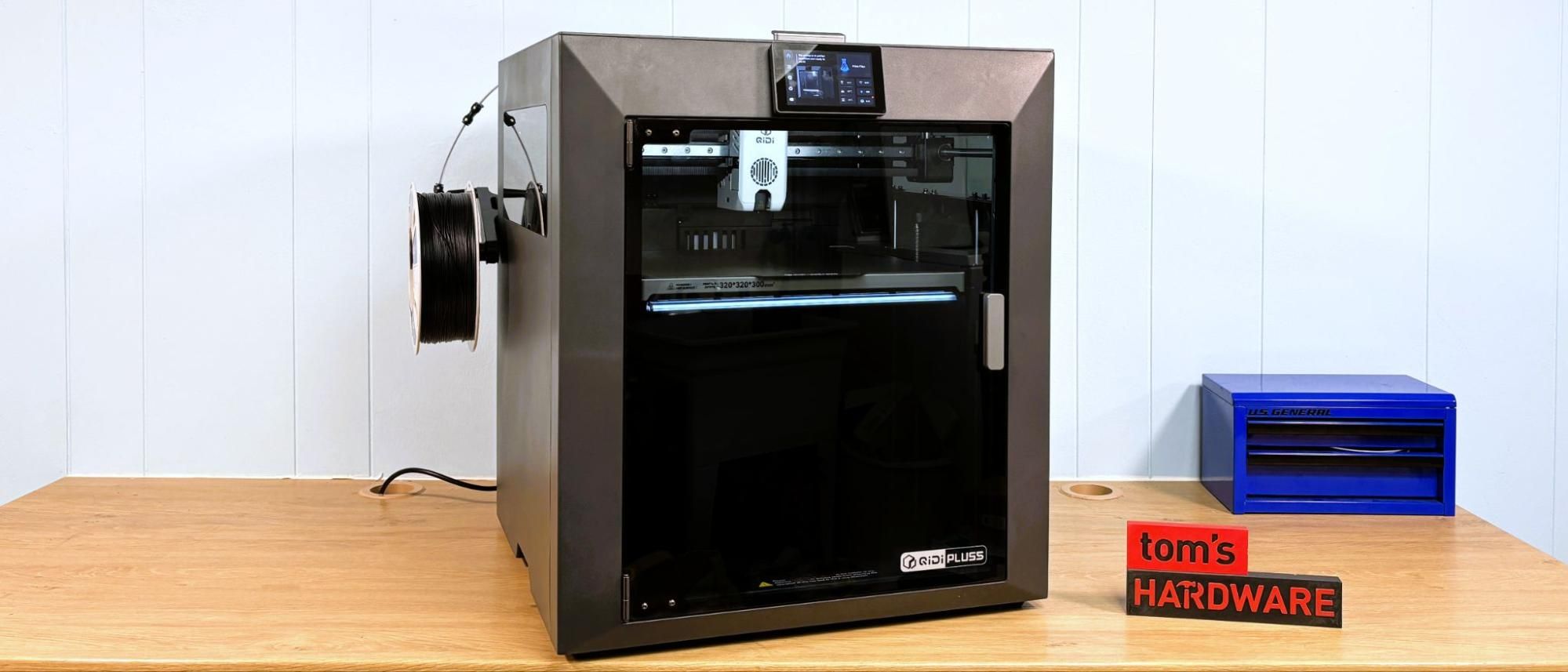
The QIDI Plus5 goes toe-to-toe with Bambu Lab’s H2 series for nearly half the price. At first glance, the QIDI Plus5 looks pretty much like the QIDI Plus4, but it’s so much more. With TARDIS-like engineering, the Plus5 has a smaller footprint, yet gains 18% more build volume than the previous model by comparison. The Plus5 can go a little hotter on the nozzle, up to 370 °C, which makes it great for tackling engineering-grade filaments.
The UI on the Plus5 is sleek and feels like a more expensive printer. It has a helpful status light on the bottom of the bed, which you guessed it, looks a lot like the Bambu H2 series. If QIDI could just get their QIDI Box to swap colors consistently, Bambu will have a serious fight on their hands.
The debut price of the QIDI Plus5 is $749, which is $50 less than the Plus4 was at launch, and is considerably less than a Bambu Lab H2S, which is currently $1399. This is definitely my favorite high-temp workhorse and one of the best 3D printers we’ve seen.
The QIDI Plus5 comes with everything you need to get started. Included is a tool kit for assembly, a scraper, a glue stick, and a USB stick with a copy of QIDI Studio and a PDF copy of the quick start guide. A paper copy of the manual is also included.
The QIDI Plus5 is a nice upgrade to the QIDI Plus4 with an extra 20mm of print area in all dimensions, with nearly the same footprint. The Plus5 is a hefty 64lbs, so you may need some help to get it in the door.
The Plus5 has a Core XY motion system, driven by a beefy 9mm 1.5GT belt, riding on a linear rail for the x-axis and linear rods for the y-axis. The z-axis runs on 4 linear rods and is driven by stepper motors turning two independent lead screws. The Plus5’s tool head is compact with an all-metal nozzle, which is shared by the QIDI Q2.
The nozzle includes the heat throat and features a hardened steel insert. The filament path is accessible in multiple locations, which should make clearing jams easy. The toolhead includes a cutter with a nearby waste chute and nozzle wiper, in case you want to try your luck with a QIDI Box for multimaterial printing. We were not provided one for this review, but we did test it out on the QIDI Q2 and found it lacking .
Get Tom's Hardware's best news and in-depth reviews, straight to your inbox.
A black plastic tube is attached to the toolhead for an optional active cooling system dubbed the QIDI Polar Cooler . This is a little AC box which can be strapped to the side of the printer and pump cooler than room temperature air directly on the extruder. This is meant to prevent heat creep when you need to keep the rest of the chamber toasty. We didn’t get to test this add-on, but it sounds intriguing.
The chamber heater and the air circulation fan, with an activated carbon and HEPA filter, are located at the rear of the printer. The HEPA filter keeps the fumes from ABS and ASA trapped inside the machine. A large parts cooling fan on the left side augments the fan on the toolhead.
The QIDI Plus5 has an excellent 1080p chamber camera, which is accessible for monitoring the printer from the device page in QIDI Studio and from the QIDI Maker app. It can be used to make time-lapse videos and is for AI anomaly detection (aka the dreaded spaghetti monster).
The printer has a glass top that is designed to slide back for ventilation while printing lower temperature filaments like PLA and PETG, and the glass front door opens a full 180 degrees. This is a simple feature that I wish more companies would adopt.
Running lower temperature filaments in the PLUS5 seems like taking a race car on a shopping trip. With a bed that heats to 120 °C, an active chamber heating to 65C and a hotend capable of 370 °C, the PLUS5 was made for PPS, PA, and PC.
The QIDI Plus5 is almost completely assembled. The only thing you need to do is attach the spool holder to the rear, then attach the bowden tubes to the spool holder and tool head. If you are assembling the printer in low light conditions, take care to avoid attaching the filament line to the inlet for the optional cooling system – they’re the same size.