Thermal pic taken under load with system tools reporting a CPU temperature of ~70 degrees Celsius.
Dive into our proprietary testing data and compare hardware with detailed benchmarks.
Go beyond the headlines with expert reporting on the hardware industry.
In-depth features, interviews and insider stories from the world of hardware.
When you purchase through links on our site, we may earn an affiliate commission. Here’s how it works .
Geekom delivers a capable older-gen Core Ultra 9 chip in a sleek compact case, supported by 24GB of soldered RAM and a 500GB SSD. More importantly, during a component crisis, you can get all of that within an $800 budget.
Why you can trust Tom's Hardware Our expert reviewers spend hours testing and comparing products and services so you can choose the best for you. Find out more about how we test .
The strategy of using last-gen laptop parts in mini PCs used to mean excellent performance at competitive prices. At least, it did until the RAMpocalypse swept across tech. Nevertheless, Geekom is pushing the idea that its IT13 Max, using a Core Ultra 9 185H at $799, offers a value option in mid-2026. Looking at some of the other prices for mini PCs we’ve seen recently, it might be right.
Other than the reasonable Ultra 9 tier price for the performance, RAM and storage in the current market, Geekom delivers a very competent mini PC here. It looks like an unassuming, business-like machine from the outside, but has plenty of ports, easy internal access, and is very sturdy.
Geekom’s new IT13 Max 2026 follows a very traditional NUC design. With its just-under-a-liter volume, this black device is just slightly bigger in every dimension than the MSI Cubi NUC AI+ 3MG (0.8 L), and shares a lot of the matte dark understated design and subtle branding of that unit. Later on, you’ll notice this pair has a lot in common when it comes to performance, too, despite being two Intel generations apart and featuring a huge price gap.
Geekom uses a matte plastic outer shell here, but the perforated venting areas to the sides and removable bottom plate are metal, as is an inner chassis. It is pretty easy to get into the IT13 Max, as there are just four screws positioned in the center of the rubber feet.
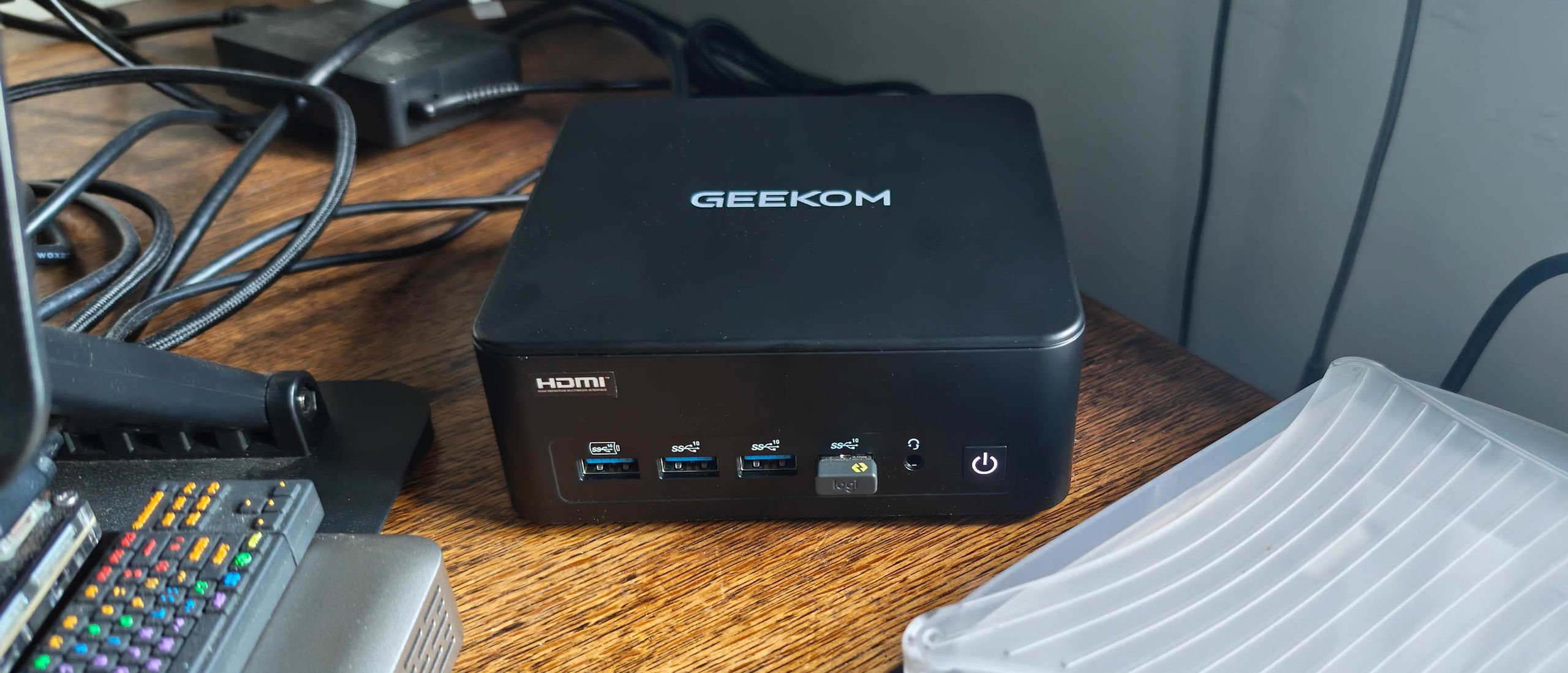
Users have access to power and headphones on the front panel, and a wide range of fast USB, networking, and monitor connection options. Geekom hasn’t implemented any biometrics in the power button, for example, and also eschews the addition of a Copilot button.
Front: 4 × USB 3.2 Gen 2 Type‑A (front, one S5 Always On), 3.5 mm audio jack. Sides: SD Card 4.0, Kensington Lock, Rear:
1x USB 3.2 Gen 2 Type‑A, 1x USB 2.0 Type‑A, 2x USB4 (both with DP-Alt, one with Power in), 2x RJ‑45 2.5 Gbps, 2x HDMI 2.0, DC‑in barrel jack
When I decided to look inside, two of the four rubber feet could be unscrewed by hand, but another pair were just a little too tight, so I had to reach for my Phillips-head screwdriver. Once you get into this Geekom mini PC, there’s not much you can do, as the RAM is soldered.
The only upgrades users have access to are swapping the installed M.2 devices. There’s an M.2 2280 SSD slot with the NVMe PCIe4 500GB Kingston drive and thermal pad in place. Under that is the system’s M.2 2230 wireless connectivity card. To the side of these, I saw a vacant M.2 2242 slot. Oddly, the spec sheet I got from Geekom mentioned 2.5-inch SATA SSD/HDD expansion options, and not M.2 2242. There seemed to be an unused SATA header area on the motherboard, so perhaps specs were changed at a late stage of development.
Get Tom's Hardware's best news and in-depth reviews, straight to your inbox.
The system offers a good array of ports built-in, and I didn’t want or need to reach for a docking solution during testing.
On the front of this mini PC, there is a generous row of four USB 3.2 Gen 2 Type-A ports. One of these supports always-on smart device charging. Next to these ports is a 3.5 mm audio jack and an inset power button with a white LED to indicate it is powered up.
On the left side, there is a full-size SD card reader, and on the right, you will find a Kensington lock slot.