Dive into our proprietary testing data and compare hardware with detailed benchmarks.
Go beyond the headlines with expert reporting on the hardware industry.
In-depth features, interviews and insider stories from the world of hardware.
When you purchase through links on our site, we may earn an affiliate commission. Here’s how it works .
Built by Channel Well Technology, the V Platinum 3000 Workstation delivers 3000W through four native 12V-2x6 connectors with excellent regulation, low ripple, and a twelve-year warranty. Efficiency clears 80 PLUS Platinum at 230 VAC, if narrowly at the top of the curve. It runs hot and loud above half load, has no fanless mode, and accepts 220-240 VAC only. Pricing is not yet announced.
Why you can trust Tom's Hardware Our expert reviewers spend hours testing and comparing products and services so you can choose the best for you. Find out more about how we test .
Cooler Master occupies an unusual position in the power supply market. Founded in Taiwan in 1992 and best known for the cases and coolers that made its name, the company has spent more than two decades selling PSUs without ever being a PSU manufacturer in the strict sense. Like most brands in this space, it commissions platforms from a rotating cast of OEMs, and the quality of a given Cooler Master unit has historically tracked the quality of whoever built it. The V series sits at the top of that catalog, and it is the line where Cooler Master has consistently spent money on the platform rather than on the sticker.
The V Platinum 3000 Workstation is something else again. Announced at the end of July 2026, it is Cooler Master's entry into the multi-kilowatt category that SilverStone opened with the Hela 3000RZ, and Thermaltake followed with the AX-3200, aimed squarely at multi-GPU AI development boxes and rendering workstations rather than at anything that could reasonably be called a home and/or gaming PC. The headline numbers are a single 12V rail rated at 250A, four native 12V-2x6 connectors, twelve PCIe 6+2 connectors, twelve SATA and four Molex, all fed from a 202 mm chassis with a twelve-year warranty behind it. The catch is on the input side: this unit accepts 220-240 VAC only, drawing up to 16A through an IEC C20 inlet, and it shuts down when the AC line drops below roughly 170 VAC. There is no 115 VAC operating mode, which is why every measurement in this review was taken at 230 VAC. We await the pricing announcement to ascertain where the V Platinum 3000 Workstation ranks among our list of best power supplies today.
The V Platinum 3000 Workstation ships in a plain kraft carton wrapped in a deep blue sleeve, with a render of the unit on the front and the badges laid out along the bottom edge: 80 PLUS Platinum (230V EU), the twelve-year warranty shield, a Japanese capacitor callout, and the ATX 3.1 with 12V-2x6 and PCIe 5.1 Ready logos. It is a restrained, business-like presentation, and appropriately so. Nobody buying a 3000W workstation supply rates shelf appeal as top priority. We should note that the 80 PLUS certification is not published on CLEAResult’s public database at the time of this review.
Inside, the supply sits between molded protective packaging. The accessory bundle is spartan: a multilingual user guide with the pin-layout diagrams, Cooler Master's recommended PCIe cable installation leaflet, and four mounting screws. There are no cable combs, no zip ties, no Velcro straps, and no storage pouch. For a unit that ships with more than thirty individual connectors, the absence of any cable management hardware is a genuine omission rather than a cost saving, and it is one of the few places where the presentation feels thinner than the product. Most importantly, however, there is no AC power cable, and this unit requires a C19 connector, which is not very common.
The modular cables are very flexible, all-black and per-wire mesh-sleeved rather than the flat ribbon types Cooler Master uses further down the range, which suits the intended market. These will be routed once, most likely in a large chassis, and left alone. The four 12V-2x6 cables use the two-color connector treatment the ATX 3.1 specification encourages, with purple latch inserts that make an incompletely seated plug immediately obvious visually.
At 202 x 150 x 86 mm the V Platinum 3000 Workstation is a genuinely large power supply. That 202 mm of depth rules out a great many mid-tower cases outright and will make cable routing awkward in several more, so this is a unit that needs to be designed into a build rather than dropped into an existing one.
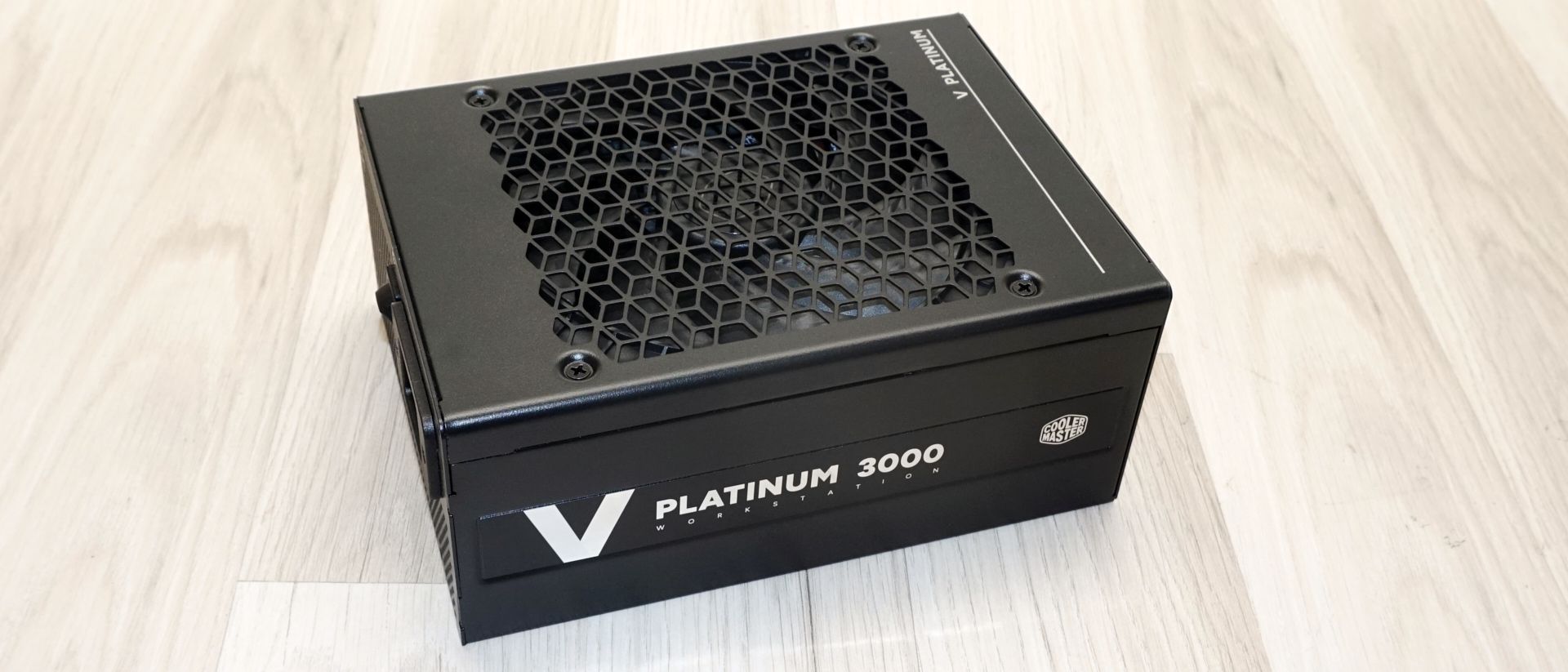
The finish is a fine-grain matte black texture, and the top face carries the same rhombille tiling fan grille pattern Cooler Master has used across the V and MWE lines, framed by four exposed screws. Decoration is limited to a thin white pinstripe running the length of the top edge, "V PLATINUM" silkscreened along one shoulder, and a recessed side plate carrying the V logo, "PLATINUM 3000" and the Cooler Master wordmark in white. An embossed Cooler Master logo sits on the underside. This unit looks more like industrial equipment than a gaming PSU, which is appropriate for a workstation PSU.
Get Tom's Hardware's best news and in-depth reviews, straight to your inbox.
The rear face is dominated by hexagonal perforation, with a 16A IEC C20 inlet - not the C14 fitting found on consumer supplies - and a typical rocker switch. The front face is entirely given over to the modular bay, silkscreened into labelled groups: two CPU/PCI-E blocks flanking a central 12V-2x6 group of four sockets, a SATA/PATA group, and the motherboard block. The specifications label lives on the top side.
Cooling is handled by a 140 mm ZI.C ZFB142512E, a three-wire model rated for 0.95A at 12V. Cooler Master specifies a fluid dynamic bearing, and the ZFB prefix is consistent with that, but ZI.C has no public specification sheet for the part. Given the twelve-year warranty and the temperatures this platform reaches under load, the fan is the component we would most like to know more about. There is no semi-passive operation: the fan turns on from the moment the unit is switched on.
The platform is a Channel Well Technology design, and the layout is the vertically stacked, multi-daughterboard arrangement CWT reaches for when a conventional flat topology runs out of board area. Transient filtering is very basic and begins behind the AC receptacle and continues on the main board, with two X capacitors, two Y capacitors, a MOV, and two large sleeved common-mode chokes. Inrush current is handled by an NTC thermistor bypassed by a Hongfa HF32F-E relay.
Rectification is done by three input bridges sandwiched together on a small dedicated heatsink, which is the first clear sign of the current this platform is built to pass. The APFC stage uses Infineon 60R060P7 MOSFETs, and its passive side is the visual centerpiece of the unit: three Nippon Chemi-Con 420V/820uF 105°C bulk capacitors, 2460uF in total, alongside two encased filtering coils, taking up nearly 25% of all the space in the unit all by themselves.
The primary inversion stage sits on its own vertical PCB and its switching devices are not visible without further disassembly, but is controlled by a Skyworks Si823380. It feeds two main transformers, PQ35/37 cores marked G09-PQ3500S-P1AR and rated Class 130(B), mounted side by side and generously taped and glued. Two transformers rather than one is the pragmatic answer to a 250A output: it splits the current, halves the copper losses in each winding, and spreads the heat across two thermal masses instead of concentrating it in one. It also, unavoidably, doubles the component count in the most expensive part of the supply.
The secondary side is built from eighteen Infineon 07N04LS6 MOSFETs performing synchronous rectification on a second vertical PCB, standing directly behind the transformers. A third vertical board carries the DC-to-DC converters that derive the 3.3V and 5V rails, with two toroidal output chokes and a bank of polymer capacitors. Secondary filtering is a mix of Nippon Chemi-Con and Rubycon parts, which makes Cooler Master's all-Japanese capacitor claim accurate rather than aspirational (which is not often the case). The modular connector board is fed by solid copper bus bars rather than wiring, and the whole assembly is conformal coated, consistent with the moisture, dust, and corrosion resistance Cooler Master claims for the unit.