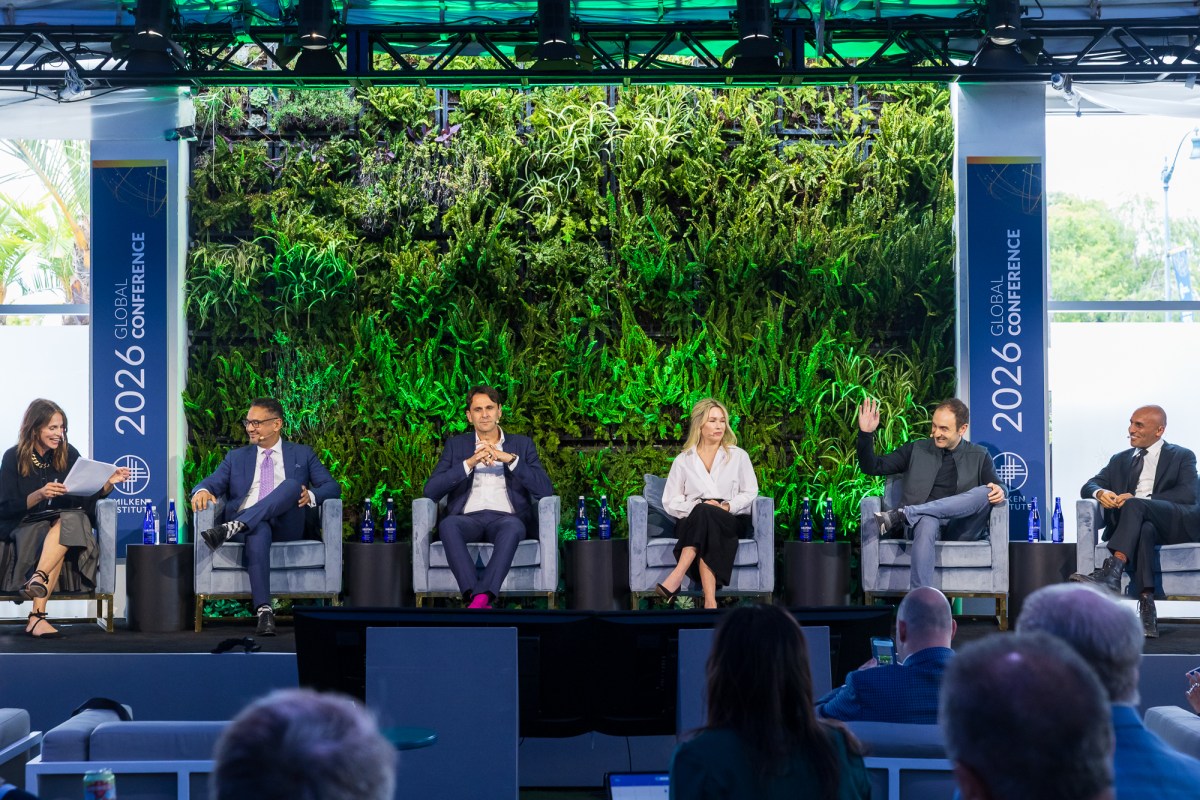
Earlier this week, five people who touch every layer of the AI supply chain sat down at the Milken Global Conference in Beverly Hills, where they talked with this editor about everything from chip shortages to orbital data centers to the possibility that the whole architecture that undergirds the tech is wrong.
On stage with TechCrunch: Christophe Fouquet, CEO of ASML, the Dutch company that holds a monopoly on the extreme ultraviolet lithography machines without which modern chips would not exist; Francis deSouza, COO of Google Cloud, who is overseeing one of the biggest infrastructure bets in corporate history; Qasar Younis, co-founder and CEO of Applied Intuition, a $15 billion physical AI company that started in simulation and has since moved into defense; Dimitry Shevelenko, the chief business officer of Perplexity, the AI-native search-to-agents company; and Eve Bodnia, a quantum physicist who left academia to challenge the foundational architecture most of the AI industry takes for granted at her startup, Logical Intelligence. (Meta’s former chief AI scientist, Yan LeCun, signed on as founding chair of its technical research board earlier this year.)
Here’s what the five had to say:
The bottlenecks are real
The AI boom is running into hard physical limits, and the constraints begin further down the stack than many may realize. Fouquet was the first to say it, describing a “huge acceleration of chips manufacturing,” while expressing his “strong belief” that despite all that effort, “for the next two, three, maybe five years, the market will be supply limited,” meaning the hyperscalers — Google, Microsoft, Amazon, Meta — aren’t going to get all the chips they’re paying for, full stop.
DeSouza highlighted how big — and how fast growing — an issue this is, reminding the audience that Google Cloud’s revenue crossed $20 billion last quarter, growing 63%, while its backlog — the committed but not yet delivered revenue — nearly doubled in a single quarter, from $250 billion to $460 billion. “The demand is real,” he said with impressive calm.
For Younis, the constraint comes primarily from elsewhere. Applied Intuition builds autonomy systems for cars, trucks, drones, mining equipment and defense vehicles, and his bottleneck isn’t silicon — it’s the data that one can only gather by sending machines into the real world and watching what happens. “You have to find it from the real world,” he said, and no amount of synthetic simulation fully closes that gap. “There will be a long time before you can fully train models that run on the physical world synthetically.”