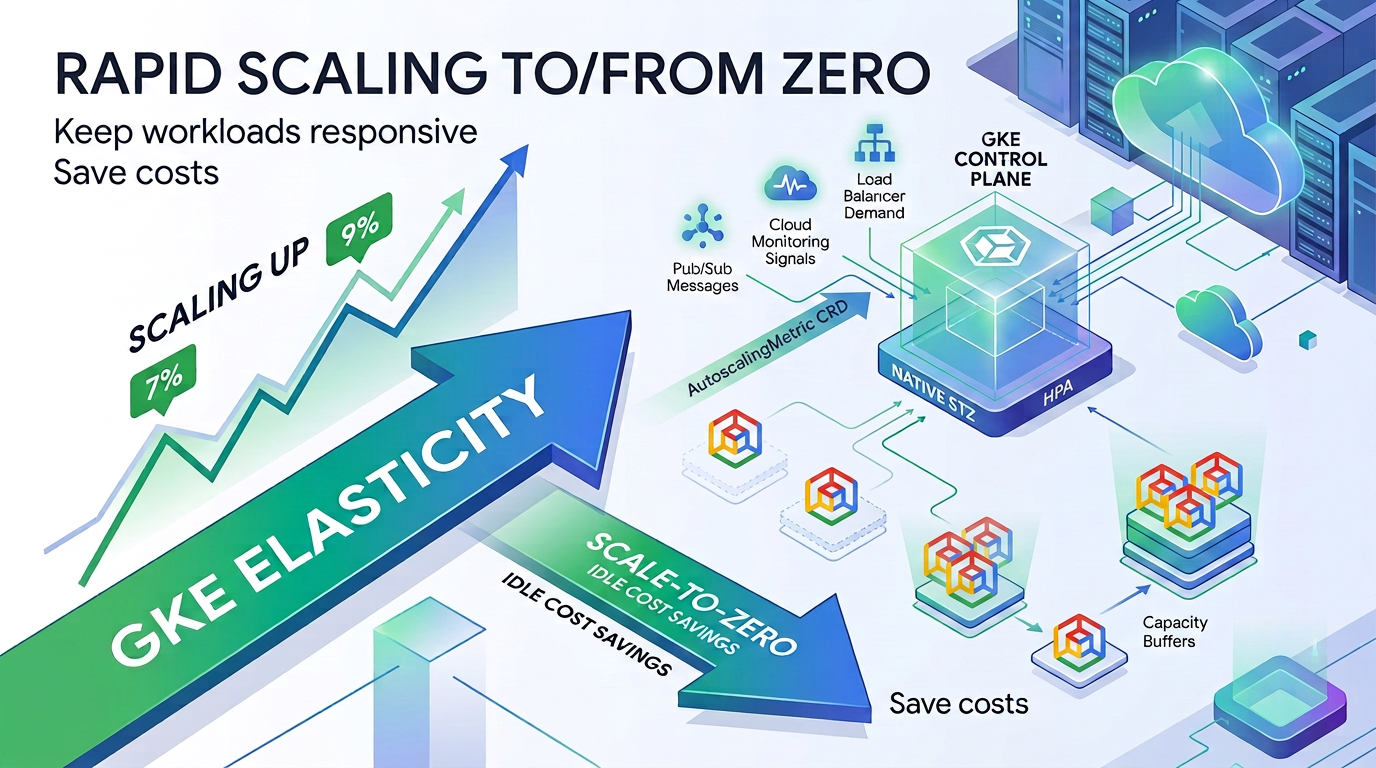
True elasticity has long been the holy grail of cloud-native engineering. And while Kubernetes has revolutionized resource management, workloads that run sporadically (e. , batch processors, event-driven workers, and development environments) still consume compute resources while they wait for work, driving up costs. We’re addressing this head-on in Google Kubernetes Engine (GKE) 1. 37 with a native way to scale to and from zero . A new collection of features allows you to scale down your workloads completely to zero replicas so that they stop consuming resources.
At the same time, you can quickly and easily restart these workloads on GKE capacity buffers when demand returns, so you waste less infrastructure. This isn't just about saving money, but about decoupling the cost of always-on infrastructure from workload readiness. For years, Kubernetes Event-Driven Autoscaling (KEDA) , an optional Kubernetes component, was the go-to solution for scaling to zero. While powerful, KEDA adds complexity to an environment. Polling intervals and hop-counts increase cold-start delays.
By baking scale-to-zero directly into the GKE control plane, we eliminate the need for add-on operators and thousands of lines of configuration. The logic moves from "sidecar management" to a native attribute of the workload. The magic behind scaling to zero within GKE lies in the integration of two critical components: HPA with AutoscalingMetric : This is the managed metrics signal pipeline that now supports direct reading of external signals from Google Cloud Managed Service for Prometheus.
HorizontalPodAutoscaler (HPA) with AutoscalingMetric provides a unified, high-performance path for metrics from Pub/Sub, Cloud Monitoring, or Load Balancer signals to reach the autoscaler, without the complexity of an adapter. KEP-2021: Built on the Kubernetes Enhancement Proposal that enables minReplicas: 0 in the HPA, this mechanism allows the HPA to stop all pods when metrics fall below a threshold. It also ensures the HPA can "wake up" the deployment as soon as the metric indicates pending work. To implement native scale-to-zero, you need two primary objects: a metric definition and an HPA.