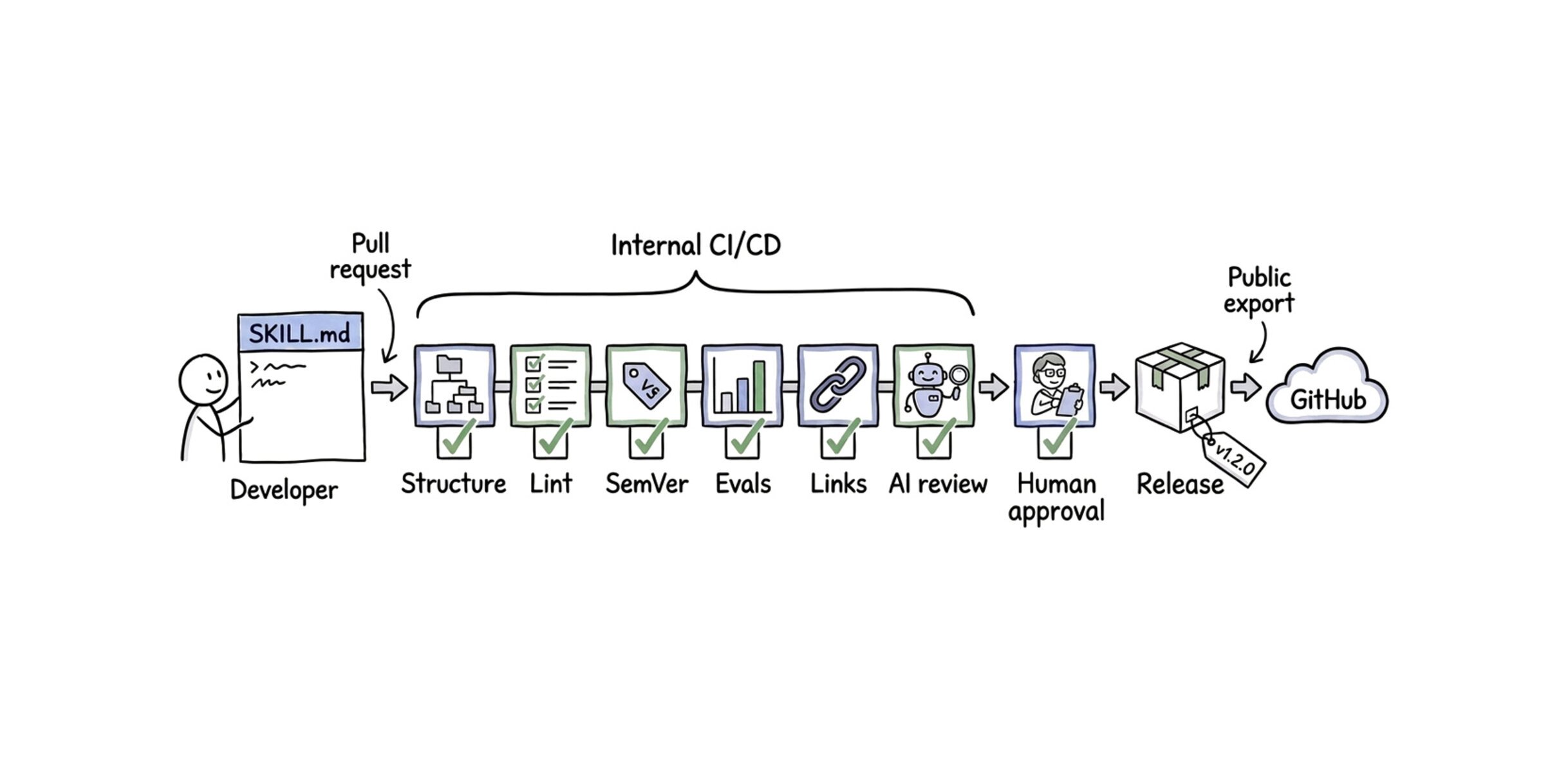
In my previous post, I took you behind the scenes of Google Agent Skills , covering how the project started, how we maintain quality at scale, and how we handle governance. In this post, I'll share what we've built since then: the automated quality gates that every change must pass, the AI review agent that inspects skill quality, and the lessons that we learned along the way. You can adopt similar gates and review rules in your own skill repository. Since my last post, the Google Agent Skills repository has passed 21,000 GitHub stars, up from 15,000.
It now hosts over 170 skills from teams across Google, and we distribute them across multiple AI platforms. Building agent skills for a single developer or a small project is straightforward. md file, define a few instructions, test it manually, and it works. At our scale, manual workflows stop being effective. Unvetted edits can introduce subtle bugs, and it becomes difficult to catch issues before they reach users. One key lesson from my previous post: a skill is a living product, not a one-off document. In practice, that means we ship every skill update like a product release.
It's tempting to treat a skill as documentation. But documentation explains concepts to a human reader, while a skill steers an AI agent's reasoning loop, tool selection, and execution path. A misplaced phrase in a skill can cause an agent to invoke invalid command flags, enter an infinite loop, or waste tokens. That makes every instruction edit a behavioral change. You wouldn't ship a product update without testing it, and the same goes for a skill. This principle drives three core requirements: Strict semantic versioning : Every behavioral change requires an explicit version bump.
Deterministic automated validation : Linters and validators check every proposed change before a human or AI reviewer sees it. Mandatory evaluation evidence : Every change includes an evaluation report. It compares the skill against its previous version, or—if the skill is new—against an agent without the skill. In my previous post, I briefly listed the checks that every skill passes on check-in: linters, link checkers, and AI-assisted checklists. Here's what's inside them, plus two gates that I haven't covered before: semantic versioning and evaluation suite validation.