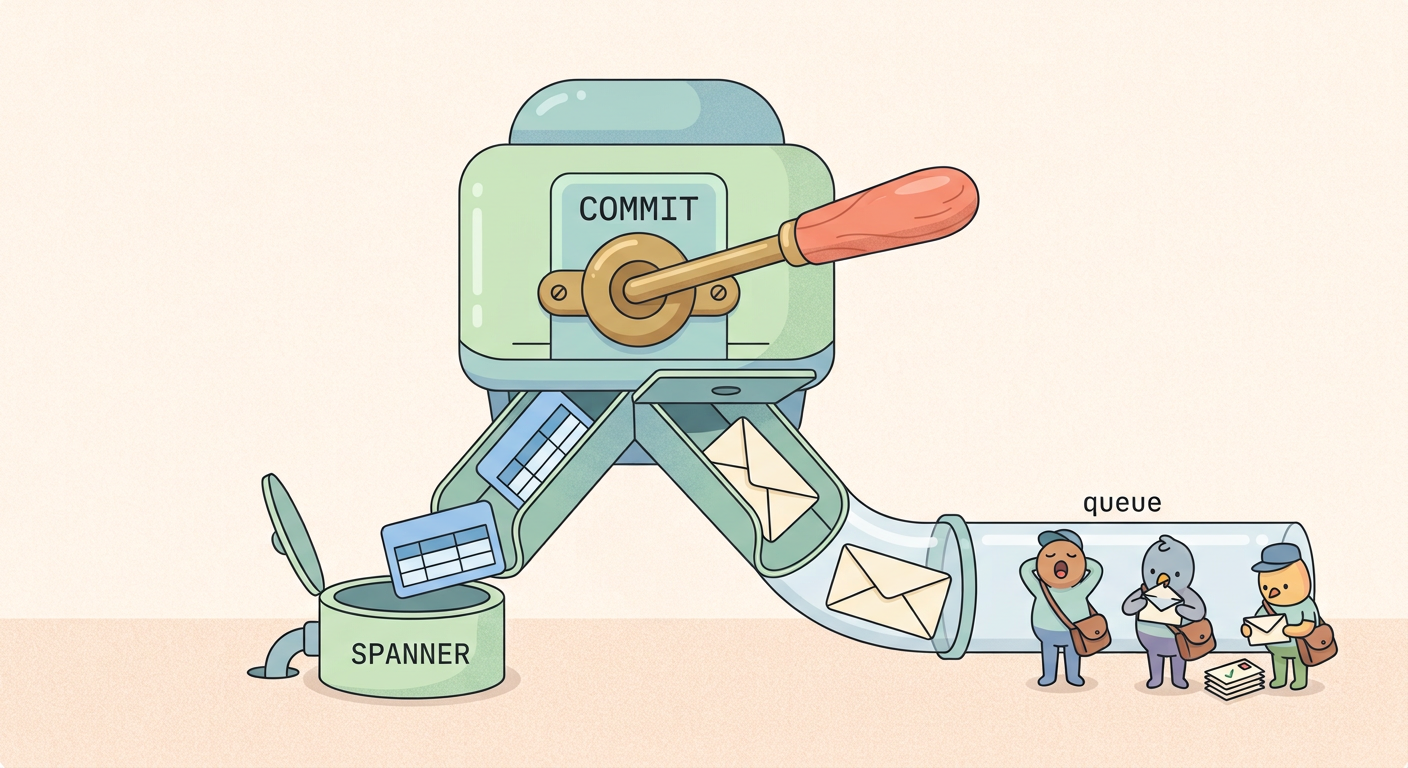
AI agents don't just answer queries — they can autonomously issue refunds, manage inventory, execute multi-step handoffs, and orchestrate sub-agents, to name but a few complex agentic workflows. That frequently requires the agents to maintain internal state in an operational database while dispatching asynchronous actions through a separate messaging or event queue system. And unfortunately for the teams building these applications, managing two systems with disjointed commit points destroys transactional consistency in agentic systems.
Today, we are excited to announce the general availability of Spanner queues : native transactional messaging embedded directly within Spanner. Designed specifically for reliable agentic execution, with Spanner queues, creating a message is simply another write in your transaction. An agent's state change and intended downstream actions commit together atomically or fail completely. Compare this to traditional approaches: When a database state update succeeds, but the action dispatch fails, your AI agent decides to act but doesn’t execute.
If the message dispatch succeeds but the state transaction rolls back, your agent executes an action based on an invalid state. In asynchronous multi-agent coordination, retries, speculation, and race conditions amplify these failures, forcing developers to build complex outbox patterns, idempotency layers, and reconciliation workers — a heavy reliability tax on agentic architecture. Spanner queues introduces several core capabilities to support these complex asynchronous workflows without introducing infrastructure overhead. Atomic decide-and-act enqueue.
Within a single Spanner read-write transaction, agents can update internal memory or state tables and enqueue tasks to peer agents simultaneously. Backed by Spanner's strict serializability and global external consistency, state changes and execution intent commit as a single atomic unit. Scheduled execution and delays. Queue messages can be dispatched immediately upon commit or scheduled for future delivery.