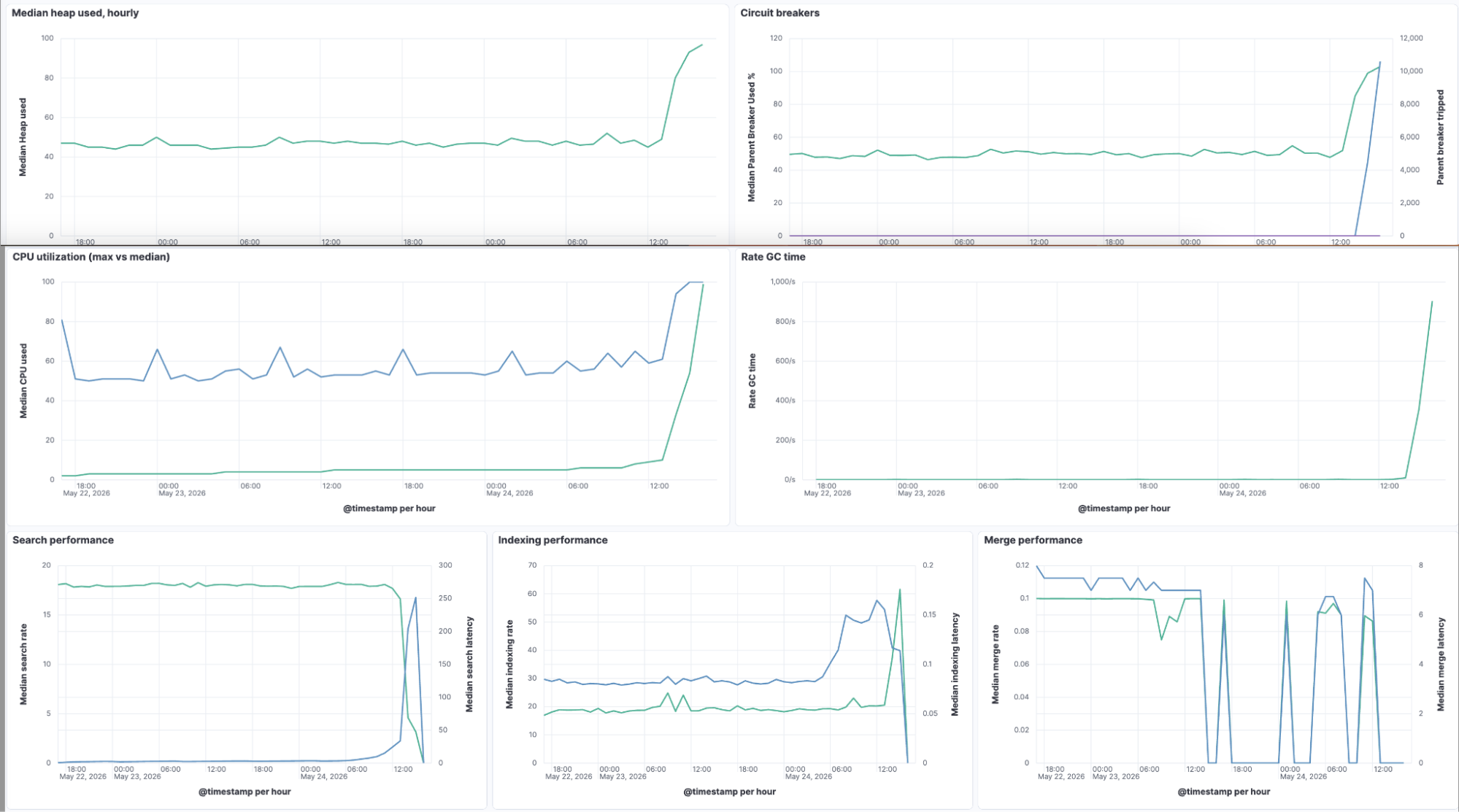
Dense vectors use off-heap memory your heap chart never shows. AutoOps detects memory pressure before vector RAM stress causes OOM. AutoOps now raises a Vector memory pressure insight when dense vector off-heap footprint, heap heat, and operational stress converge on the same Elasticsearch node. We validated on a 4 GiB node under sustained k-nearest neighbor (kNN) ingest: The insight fired at ~75% heap with thread-pool stress, roughly an hour before saturation. Heap charts alone still looked moderate at that point.
Dense vectors for kNN live outside the Java heap, so heap monitoring and circuit breakers never show the full vector RAM picture. Below, we walk through what the insight measures and why heap on its own misses this. We also discuss what to do when it fires. Semantic search and kNN rely on dense_vector fields . Elasticsearch stores much of that data in off-heap memory. It’s related to how the Java Virtual Machine (JVM) operates, but it isn’t the same thing as heap usage.
In production, the heap versus off-heap split shows up in a familiar pattern: Heap looks fine for weeks, while the dense vector off-heap footprint quietly grows. Heap circuit breakers stay quiet or only spike late because the pressure sits outside the JVM. kNN search and bulk ingest slow down, queues build, and nothing on the dashboard points at vector RAM as the cause. Heap limits protect Java allocations. They don’t tell you whether vector off-heap footprint still fits the RAM envelope that your deployment actually runs in.
AutoOps already watches cluster health broadly; Vector memory pressure adds a focused read for vector-heavy nodes when memory and load signals line up. AutoOps works from the same node stats metrics you already use for Stack Monitoring. For each node, it tracks three derived numbers: Delta between os. used_in_bytes H > 0 means there’s a modeled runway: Vector use still fits comfortably in that accounting. H ≤ 0 means that you’re in a compression regime: Vector footprint (V) meets or exceeds the free RAM (A) picture that AutoOps can align in telemetry. On small tiers, that can be common under load.