A technical walkthrough of precomputing facts into an Elasticsearch AI Index, so agents answer from a single ES|QL query instead of reading whole documents, with fewer tokens and lower latency. Elasticsearch has native integrations with the industry-leading Gen AI tools and providers. Check out our webinars on going Beyond RAG Basics , or Building Prod-Ready Apps with the Elastic vector database. To build the best search solutions for your use case, start a free cloud trial or try Elastic on your local machine now.
Pulling whole documents into an agent's context to answer one question is expensive, and the cost compounds with every miss. In this walkthrough, we precompute the facts instead. A Kibana workflow distills each document into a fact-level Knowledge Indicator (KI), stored in an Elasticsearch AI Index and retrieved with a single Elasticsearch Query Language (ES|QL) query. On the same question, an agent answering from KIs reached the same grounded answer using fewer tokens and lower latency than reading raw documents, without loading a single full document into context.
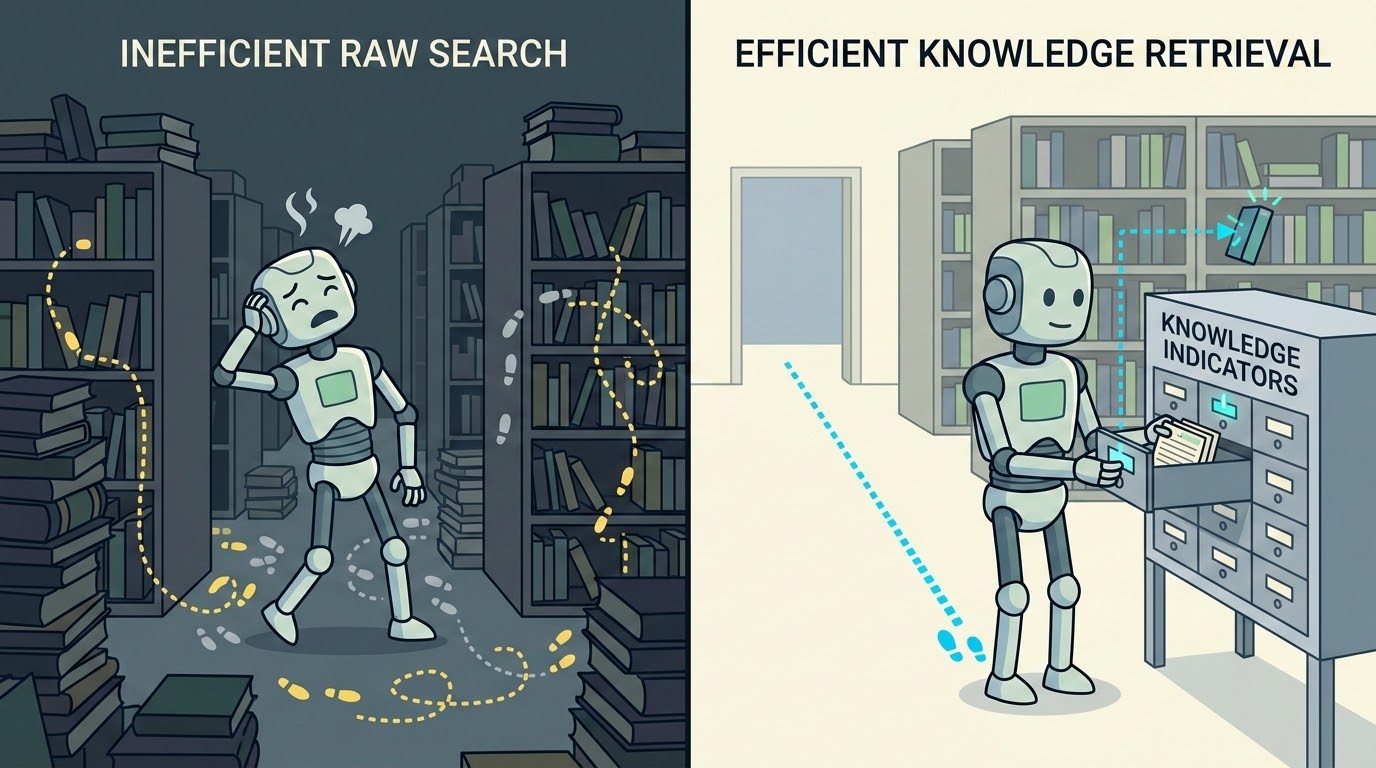
These facts are precomputed once and then stored for use by future agents when they encounter similar queries. This is Part 2 of our series on building context with AI indices; Part 1 covered routing agents to the right index. Managing context depends on good retrieval. Rather than have agents rediscover the same content for every question, burning tokens by retracing similar steps over and over again, Elastic’s agentic AI capabilities enable us to precompute these details and store them in a structured, searchable form, and they let agents load that context directly.
We call this precomputed unit of context a Knowledge Indicator. The default agentic retrieval augmented generation (RAG) pattern does the opposite. It retrieves whole documents and dumps them into the model's context at query time, paying for that retrieval in tokens and latency on every single question. Precomputing the answer as a KI moves that cost out of the hot path and does it once.