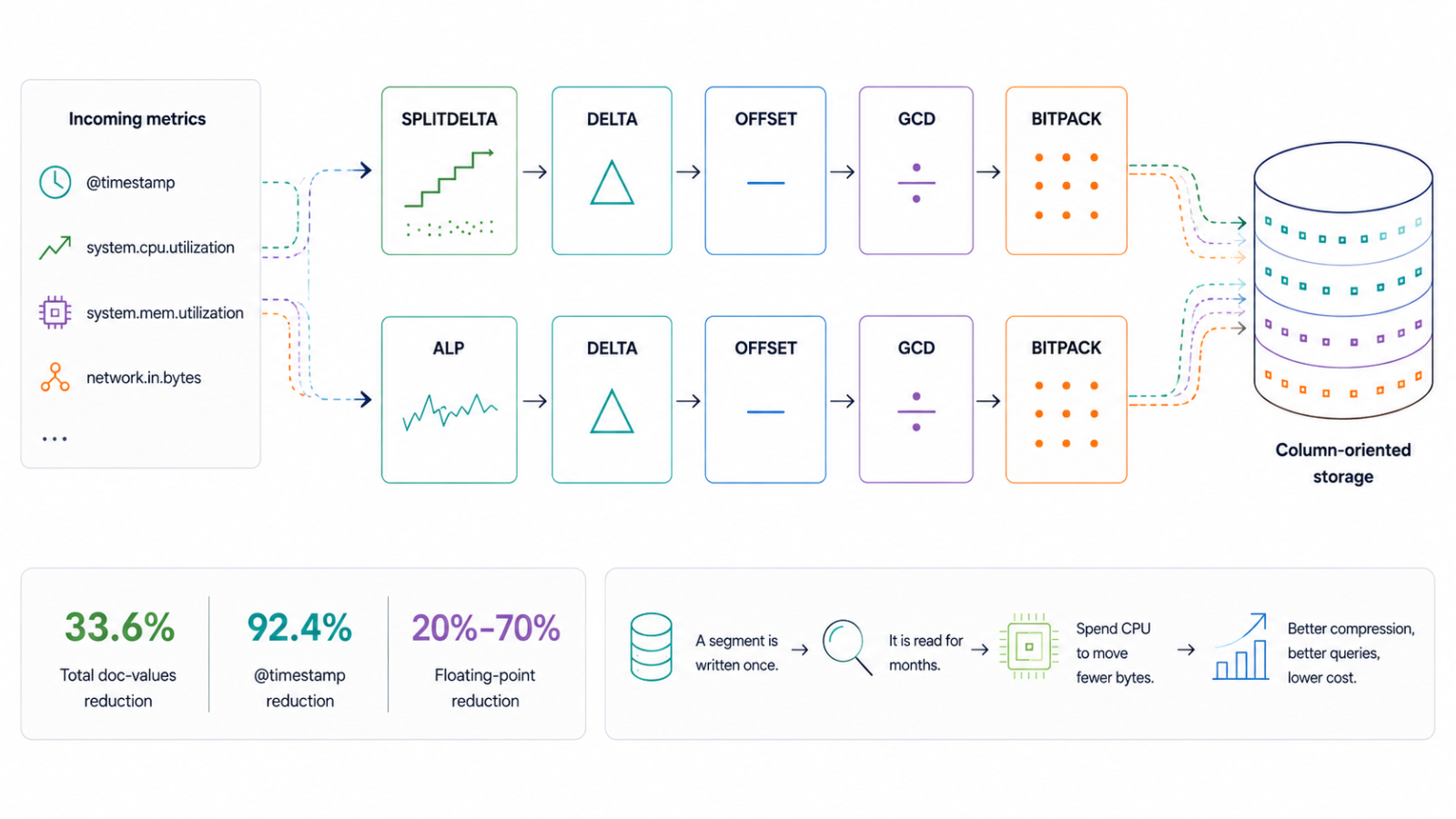
5's new adaptive time series codec that cuts @timestamp storage by 92% and floating point fields by up to 74%, with zero configuration. The best compression strategy is the one that understands your data. Observability workloads are storage-intensive by nature, and the composition of that storage determines both cost and query performance. ES95 introduces adaptive compression: rather than applying the same encoding to every numeric field, it automatically selects the encoding that best matches each field's structure.
6% reduction in total doc-values storage, 19% to 74% reduction on floating-point gauge metrics and a 92% reduction in @timestamp . No configuration or migration required. Data processing systems are rarely limited by how fast they can compute. They’re limited by how fast they can move bytes: off disk, across the network, and through the memory hierarchy. Compression is how a storage engine trades CPU time for memory bandwidth, spending comparatively cheap CPU cycles so fewer bytes have to travel through the parts of the system that are usually constrained.
In a read-heavy system like Elasticsearch, that trade-off pays back every time data is queried, often long after it was written. Storage size and query performance move together; fewer bytes on disk means fewer bytes to read on every range query, every aggregation and every dashboard load. Compression is not just about saving storage. Every byte that is never written is also a byte that never has to be read. The right encoding depends on the structure of the values themselves, and the largest wins come from exploiting the structure already present in the data rather than squeezing an opaque stream of bytes.
Few workloads expose that structure more clearly than observability metrics. A single host reports hundreds of metrics every few seconds, including CPU utilization, memory ratios, request latencies, and network throughput. Multiply that by thousands of hosts across weeks of retention, and the bytes accumulate fast. Most of that volume is structured but not uniform: timestamps arrive at near-constant intervals from thousands of concurrent series, counters increase monotonically, while gauges like 23. 15 are short decimal measurements. A fixed compression approach cannot adapt to that variety.