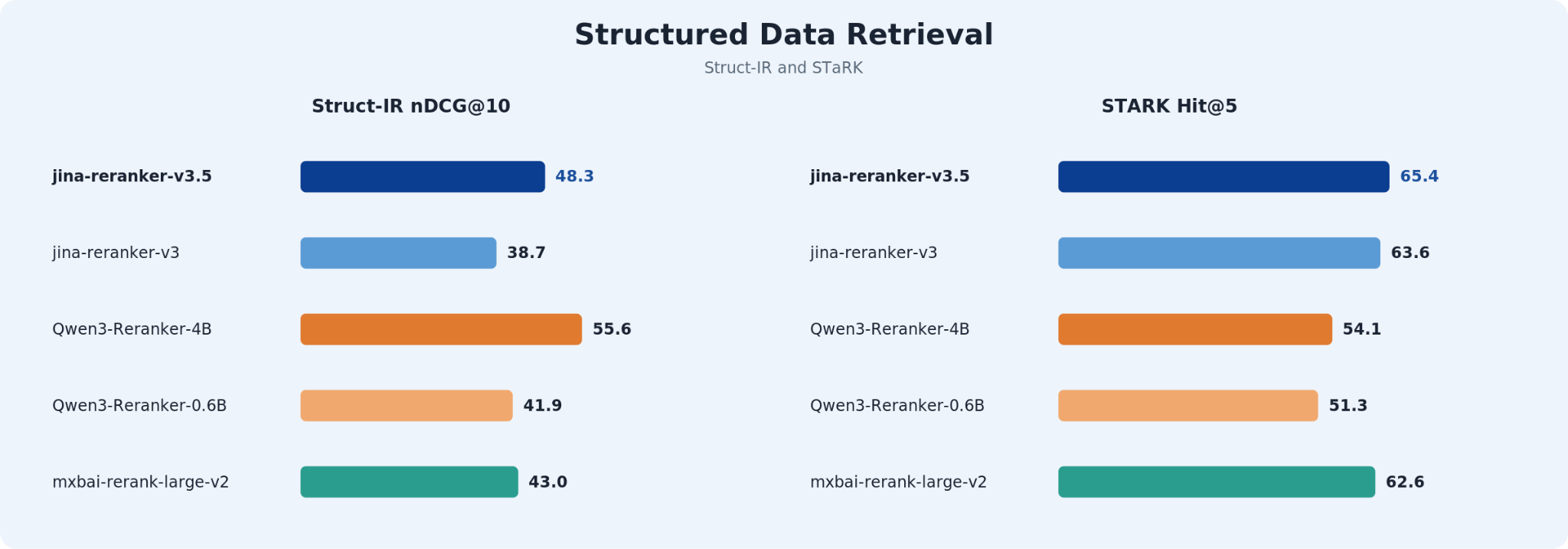
5 beats v3 by 50%+ on case law, closes the gap with models 7x its size on legal, medical, and financial benchmarks, and beats them outright on structured data. It's a drop-in replacement for v3, with no API changes. 5 is a 600 million parameter reranker that delivers major gains over its predecessor, jina-reranker-v3 , on legal retrieval, and closes most of the gap to models seven times its size on legal, medical, and financial reranking. On long documents, it runs up to 56% faster than jina-reranker-v3 and scores over 50% higher on case law retrieval.
It also beats Qwen3-Reranker-4B on the STaRK structured data benchmark. "It’s a drop-in replacement for v3 users and requires no changes to the code that accesses the model. A reranker is an AI model used near the end of an information retrieval pipeline, after other modules have assembled a short list of candidate matches to a query. It’s trained to order the candidate list from best matching to least. Using a specialized model focused purely on ranking candidate matches can improve result quality dramatically.
Jina AI’s latest rerankers use a technique called late interaction , where queries and documents are encoded separately into lists of token embeddings that reflect each token’s semantics in context and then compared to each other. This is an AI analog of lexical and grammatical disambiguation. For example, consider the meaning of the word match in these two sentences: The first sentence might be a match for queries about matchboxes; the second for queries about romance. Transformer-based models do this kind of in-context disambiguation but bring much richer information into the token embeddings they produce.
The word match might have a semantic embedding near to words like fire or illumination in the first sentence, while in the second, it might be closer to smartphone or swipe . Late interaction rerankers generate these context-enriched token embeddings for both the query and the candidate documents and then compare them to produce sortable scores. They’re completely agnostic about how candidate match lists are created.