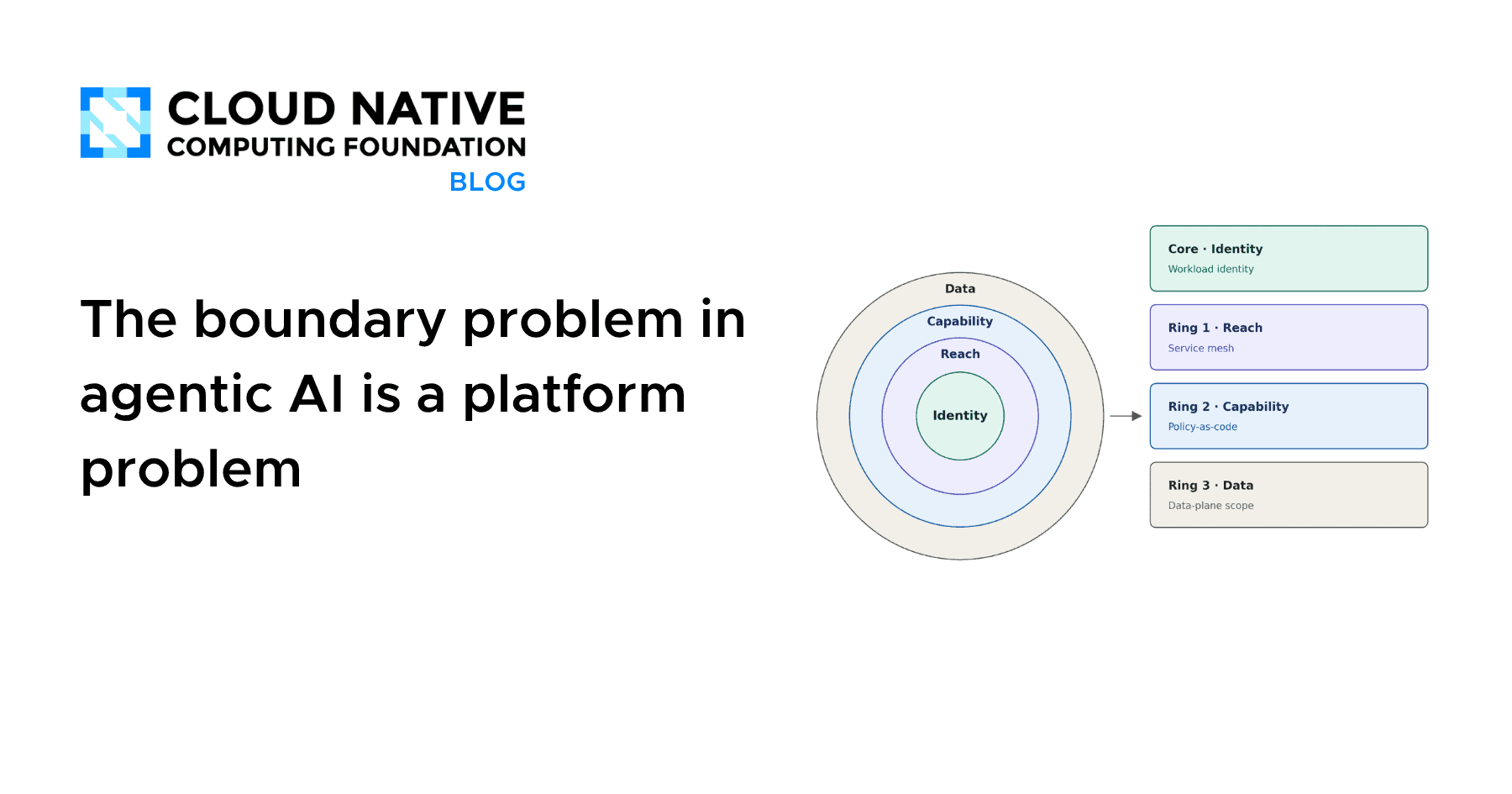
Posted on October 29, 2026 by William Rizzo (Field CTO, Kairos Maintainer, CNCF Ambassador) and Francesco Beltramini (Field CTO) An autonomous agent will do exactly what its tools let it do, and no more. This sounds like a constraint. In practice it is the whole risk, because the set of things an agent's tools let it do is almost never the set anyone deliberately chose. It is the set that accumulated. A tool added for one workflow stays available for every workflow. A credential scoped for a demo survives into production. A delegation added to unblock a Friday deploy becomes a permanent edge in the graph.
Nobody decides to give the agent that reach. There was never a moment where reach was decided at all. This is the pattern worth naming. It is not a bug in any particular agent framework and it will not be fixed by a better prompt. Across enough deployments the same shape recurs: authority is granted incrementally, locally, and invisibly, and the system's actual power drifts steadily away from anyone's model of what it should be able to do. The boundaries erode anyway. By the time someone asks "wait, can it do that? ", the honest answer is usually "it could for weeks, and we only noticed now.
" The instinct is to treat this as a governance failure and answer with process and review boards. That instinct aims at the wrong layer. Process governs the decisions humans make. This problem is largely about the decisions nobody makes, the capabilities that arrive without a decision, and you cannot review a class of change that never surfaces as a change. What is needed is not more vigilance over the agent. It is a substrate that holds the line whether or not anyone is watching.
The tempting shortcut is to make the agent responsible for its own limits: tell it in its instructions what it may and may not do, and give it a sense of its own scope. This fails structurally, and the failure looks like success right up until it doesn't. An agent's output is a probability distribution over next actions, conditioned on context. Most of the time the most probable action is the appropriate one, which is exactly what makes agents useful and exactly what makes them dangerous to trust.