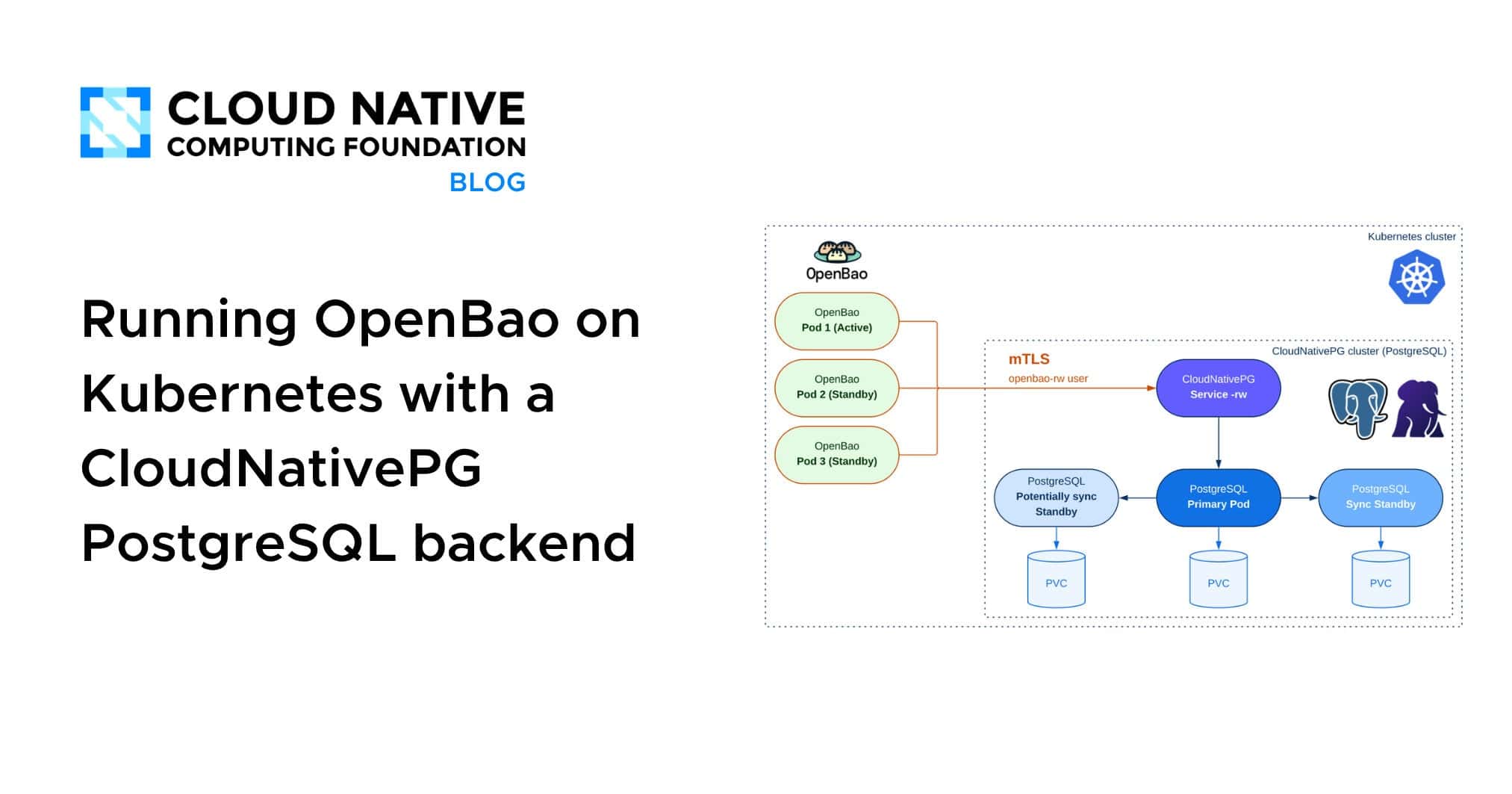
Posted on September 16, 2026 by Gabriele Bartolini (EnterpriseDB) and CNCF Ambassador, Rob Kenefeck (ControlPlane) Managing infrastructure secrets on Kubernetes needs a backend that is self-healing and free of vendor lock-in, and that is exactly what OpenBao (the Linux Foundation's open-source fork of HashiCorp Vault) and CloudNativePG give you: an entirely open-source stack built on two CNCF projects, Kubernetes , long since graduated, and CloudNativePG, a CNCF Sandbox project currently under evaluation for Incubation by the CNCF Technical Oversight Committee.
OpenBao's postgresql storage backend turns any PostgreSQL cluster into its encrypted key-value store, and CloudNativePG turns that cluster into a self-healing, synchronously replicated, certificate-authenticated Postgres instance with no cloud database dependency underneath it. This recipe deploys a three-instance CNPG cluster as OpenBao's storage backend and removes every password from the connection: the schema-owning role and the application role OpenBao itself uses both authenticate with a DatabaseRole-issued TLS client certificate, enforced by explicit pg_hba rules rather than by the absence of a password.
conf is PostgreSQL's client-authentication file, the thing that actually decides, per connection, whether a role needs a certificate, a password, or nothing at all. Nothing about this recipe is specific to any one Kubernetes distribution: any conformant cluster with enough worker capacity will do. To follow along locally, though, the official cnpg-playground repository is the fastest path to one, since it is pre-configured with the CloudNativePG operator already.
It is designed primarily around CNPG's own demos, so it is worth knowing what it actually gives you: a single Kind cluster with six nodes, a control plane node, one node labelled for infrastructure workloads, one labelled for application workloads, and three carrying a node-role. That taint is exactly what our Cluster ‘s tolerations in Step 1 target, and it is also what leaves OpenBao itself with only the two general-purpose nodes to schedule onto, which matters once pod anti-affinity enters the picture in Step 3.