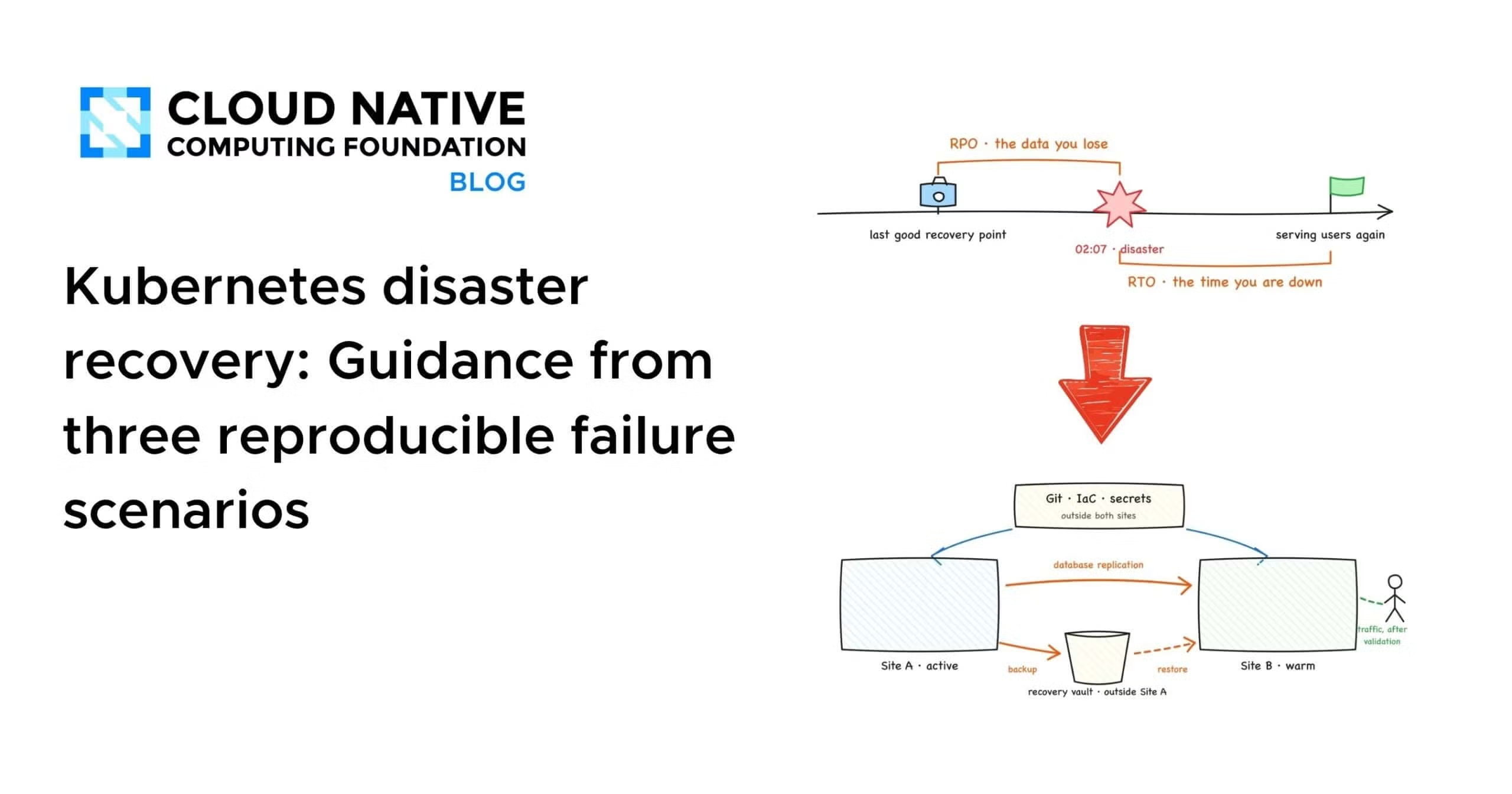
Posted on September 10, 2026 by Saiyam Pathak, Saloni Narang | CNCF Ambassadors This document describes three failure scenarios that separate having backups from being able to recover, and the guidance that follows from each. Every scenario is reproducible on a laptop from the lab repository above, and every terminal output shown is a real capture from that lab. The document covers recovery of stateful applications running on Kubernetes: verifying that backups contain data, the split between declared state and stored state, and consistency across multi-volume applications.
It does not cover compliance frameworks, product comparisons, or recovery of the underlying cloud or datacenter infrastructure, though it names where those responsibilities begin. Specific tools appear where a scenario needs them (Velero, the CSI snapshot APIs). They are reference implementations used to make the scenarios concrete. The failure modes and the guidance apply to any tool occupying the same role. Each layer has mature tooling, and each usually recovers fine in isolation.
Recovery fails at the joins between the layers: a restored cluster with no data, restored data with no traffic path, an application definition that provisions an empty volume. The three scenarios below each break one join. The workload is a PostgreSQL application with known contents (four rows), so every restore can be validated against an expected result rather than against a green dashboard. Backup tool moves objects and volume bytes to an S3 store A Kubernetes backup has two distinct parts: the resource definitions (YAML) and the persistent volume data.
Backup tools protect volume data through provider or CSI snapshots, file system backup, or snapshot data movement to an external store. The lab uses the last of these, with Velero and its data mover. Most verification stops at the backup’s Completed status. Go one step further and confirm that volume bytes actually moved: This is the data mover confirming that 47,989,888 bytes of volume data left the cluster and landed in the external store. A backup tool that cannot report this number for a given backup deserves scrutiny.