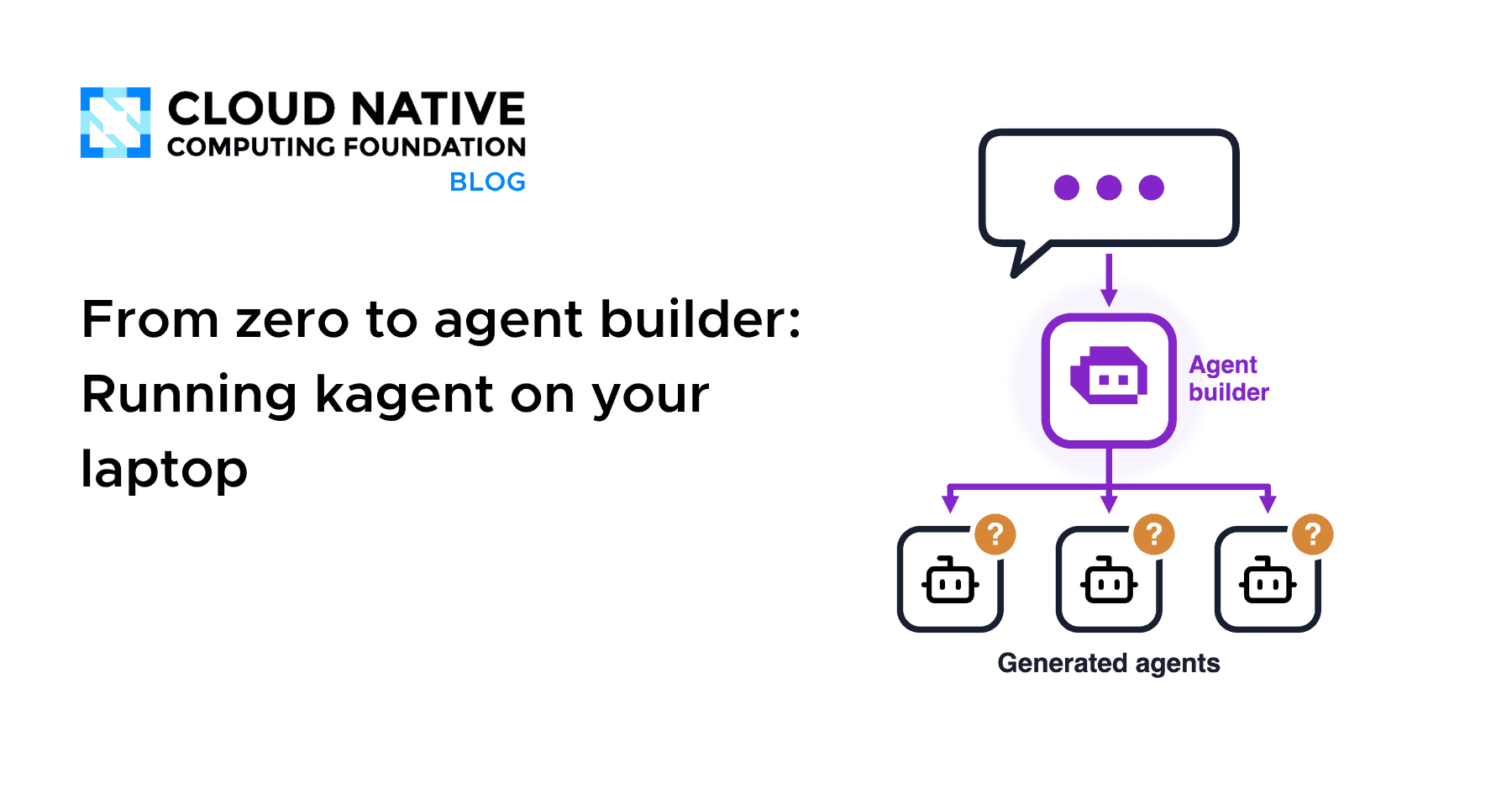
Posted on October 12, 2026 by Antonio Berben(Solo. io) and Felipe Vicens(Telefónica) If you have seen a demo of a no-code agent builder, you know the moment. Someone types one sentence, waits a minute, and there it is: a new agent, running, with tools. Then the questions start. This post is about the first part, the ten impressive seconds. I want to show that it is not magic and that you can build it yourself, in an afternoon, with open source and spending a minimum on tokens. The tool is kagent , a CNCF Sandbox project that runs AI agents as Kubernetes resources.
The questions come back at the end, because they are the real work. In kagent, an agent is not a process you start by hand. You write an Agent with a system prompt, a model, and a list of tools. You apply it, and the controller turns it into a running pod that speaks A2A . Once agents are just YAML, an agent that builds agents is simply an agent that can write one kind of YAML. No new framework, no plugin. One Agent , three tools, and a prompt that knows what an Agent looks like. The goal here is the builder.
Security is out of scope, on purpose, and I want to be upfront about what that means: That is fine for a laptop. It is not fine for a shared cluster, and I will come back to why that gap matters. You need Docker, kind, kubectl, helm, jq and Ollama (alternatively, you can use your API Key for Claude, OpenAI, or any other provider, but we wanted to make it as cheap as possible). There is nothing to clone: you create every file as you go. Start in an empty folder: This is the part that surprised me. Writing a valid Kubernetes manifest through a tool call is harder than chatting, and small models show it.
5:7b-instruct invented its own tool block format, and qwen2. 5:14b-instruct sometimes answered politely without ever calling the apply tool. qwen3-coder:30b-a3b got it right on every run, so that is the model this post uses: The cluster reaches Ollama at host. internal:11434, which works out of the box with Docker Desktop. On Linux you have to change that host in the values file below to an address the kind node can reach. I have not tested that path. If you prefer a hosted model, kagent’s Helm chart also has provider blocks for OpenAI, Anthropic, Azure Op